Compare USDT Earn Options & Risks Before Depositing
Contents
You have USDT sitting there. You see numbers like 5%, 10%, even 15% APY advertised on exchanges and apps. It is tempting. The promise is simple: deposit, sit back, watch it grow. But the real question should not be “how much?” It should be “where does that yield actually come from, and what can go wrong?”
Chasing the highest advertised rate without looking at what is underneath is the fastest way to get burned. This article walks through the practical options for earning on USDT without trading, so you can compare them by what matters: custody, yield source, exit terms, and real risks.
Quick Answer: How to Earn on USDT Without Trading
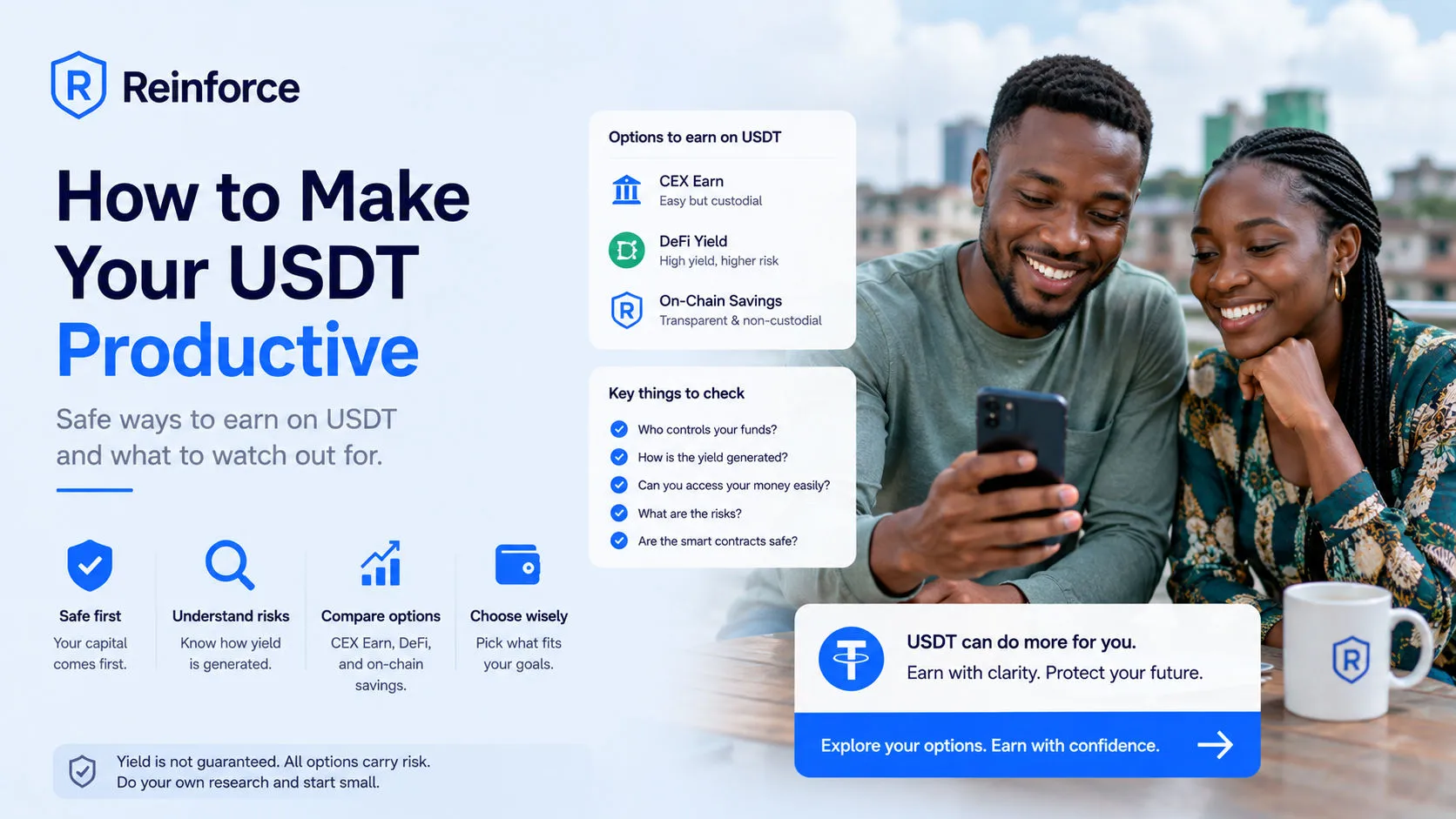
You have three broad paths to make idle USDT productive, and each has a totally different risk profile:
- Keep it liquid on a centralized exchange (CEX) in a flexible Earn product: easy, no lock-up, but your USDT is under the exchange’s control. If the exchange freezes withdrawals or gets into trouble, your access can disappear overnight.
- Deposit into a lending protocol through a wallet app: often offers higher rates because you lend directly to borrowers on-chain, but you now carry smart contract risk and need to manage your own wallet.
- Move it into an on-chain savings layer designed for transparency: you deposit USDT and receive a token that represents your position (like TRUSD from Reinforce). The mechanics of yield, reserves, and redemptions can be inspected on-chain, but you carry smart contract, peg, and liquidity risk.
The common thread? Every option that generates yield carries risk. The job is not to eliminate risk—it is to understand it in plain terms before you deposit a single USDT.
Why APR Is the Last Thing You Should Look At
A high APR number tells you nothing about safety. In fact, when a platform advertises a double-digit rate that feels too easy, your first thought should be to figure out who is paying for that yield and what happens when demand for borrowing dries up.
Yield on USDT mostly comes from lending. Borrowers pay interest, and that interest gets passed to you, minus fees. When traders are leveraged and markets are hot, borrowing demand spikes and rates go up. When the market cools, rates can collapse to near zero. Some platforms subsidize rates with their own tokens to make the number look artificially attractive. That can end without warning.
So before you even look at the percentage, ask these questions:
- Who has custody of my USDT?
- Where is the yield coming from—real lending demand or marketing subsidies?
- Can I exit immediately, or are there hidden delays and limits?
- What happens if the platform or protocol fails?
Comparing USDT Earn Options: Custody, Liquidity, and Risk
The table below gives you a side-by-side look at the most common routes a practical USDT holder in Nigeria or similar markets might consider. Read it for the trade-offs, not for a winner.
| Option | Custody | Yield Source | Lock-up / Exit | Main Risks |
|---|---|---|---|---|
| Exchange Flexible Savings (Binance, Bybit, OKX) | Exchange holds your USDT | Exchange lends to institutions, traders, or uses internal pools | Usually no lock-up; withdrawals normally fast | Counterparty risk (exchange failure, frozen withdrawals), changing rates |
| Exchange Fixed-Term Savings | Exchange holds your USDT | Same as flexible, with committed capital | Locked for a set period; early exit may cost interest | Same as flexible, plus you give up access for a higher rate |
| Wallet App Earn (Trust Wallet, etc.) | You hold the tokens; app routes to DeFi protocols | Lending on protocols like Aave, Morpho | Usually no lock-up, but protocol withdrawals depend on liquidity | Smart contract risk, protocol exploit, wallet management mistakes |
| On-Chain Savings (Reinforce.fi) | You hold TRUSD in your wallet | Reinforce savings system; on-chain mechanics | Designed to be redeemable to USDT, subject to protocol conditions | Smart contract risk, peg risk, liquidity risk, gas fees |
When Keeping USDT Liquid Makes More Sense
Not every dollar needs to be working. If you use USDT for P2P trades, freelance payments, or regular business cash flow, locking it up—even in a flexible product—adds an extra step when you need to move fast. Withdrawals can be delayed, flagged for review, or batched during high demand. If you would lose sleep worrying about whether you can access your money in 10 minutes, just hold it liquid in a wallet you control.
When a CEX Earn Product May Fit
CEX Earn products are convenient. You do not have to manage a wallet seed phrase or sign on-chain transactions. The interface looks like a bank app. But the trade-off is always the same: you hand custody of your USDT to a company. If that company pauses withdrawals—something that has happened multiple times in crypto history—you are stuck, no matter what the app says about “flexible” or “instant.”
If you go this route, start with the smallest amount the product allows and withdraw it immediately after. See how long it actually takes, whether fees get deducted, and whether any terms change mid-process. Then decide if you trust it with more.
When an On-Chain Savings Option May Fit
On-chain savings means you do not hand custody to an exchange. You deposit USDT into a protocol and receive a token that represents your position. That token sits in your wallet. You can check on-chain what is happening with reserves, redemptions, and contract activity—depending on the dashboards and documentation the protocol provides.
Reinforce.fi is built around this idea. You deposit USDT and receive TRUSD, Token Reinforced USD. TRUSD is designed to be USDT-pegged and yield-bearing. It is designed to be your position marker in the Reinforce savings system, not an IOU from a centralized company.
This model shifts the risk from a company to code and market mechanics. You carry smart contract risk—the code could have bugs or be exploited. You carry peg risk—TRUSD could trade below its intended value. You carry redemption risk—converting TRUSD back to USDT relies on protocol liquidity and conditions. And because you hold TRUSD in your own wallet, you also carry the full responsibility of not losing your seed phrase and not signing malicious approvals.
This is not automatically safer than an exchange. It is a different set of trade-offs. If the idea of holding a token where your exit depends on a protocol’s reserves makes you uncomfortable, a CEX product might actually feel simpler. What on-chain savings offers is transparency: the mechanics are inspectable, and no one company can unilaterally freeze or mismanage the pool in secret. For users who want that clarity and are willing to learn the risks, it is worth comparing.
If you are curious about how Reinforce works, start small. Deposit an amount you are okay losing. Test the redemption flow. See how long it takes, what gas fees you pay, and whether the peg holds close to USDT. Use the experience to decide if the model fits how you think about your idle USDT.
Common Mistakes to Avoid
You can avoid most serious losses by simply not doing these things:
- Choosing only by APR: the highest number advertising today often hides the weakest foundation.
- Depositing before you understand the exit: if you do not know exactly how and when you can get your USDT back, do not deposit yet.
- Trusting a guarantee a platform cannot give: no Earn product is “safe” in an insured, bank-account sense. Anyone saying otherwise is misleading you.
- Ignoring gas fees: on-chain options cost gas to enter and exit. On Ethereum, that can eat a large chunk of your deposit if you are testing with a small amount. Check network fees before you act.
- Keeping all USDT in one place: if you hold your entire stablecoin balance in one exchange or one protocol, one problem means zero access. Split your approach.
A Practical Decision Framework
Before you deposit your USDT anywhere, work through this short checklist. Answer honestly.
-
How quickly do I truly need to access this USDT?
- In minutes: keep it liquid in your own wallet.
- In days: a flexible product or on-chain option may work, if you can tolerate delay.
- In months: a fixed-term option might be worth the extra percentage—if you accept the lock-up fully.
-
Who controls my USDT after I deposit?
- The exchange: understand that your access depends on their decisions.
- A smart contract: understand that your access depends on code and liquidity.
- Me, via a position token: understand the peg and redemption mechanics completely.
-
What am I really being paid for?
- Lending demand that can vanish.
- Marketing subsidies that can be pulled.
- A protocol’s yield design, which may change.
-
Can I test it small first?
- If the answer is no, walk away.
- If yes, deposit a tiny amount, go through the full deposit-and-exit cycle, and only then commit more.
FAQ
Is USDT Earn safe?
No product that generates yield is completely safe. Every option carries different risks: counterparty risk with exchanges, smart contract risk with on-chain protocols, and peg or liquidity risk with stablecoin tokens. “Safe” is always relative. The practical question is which risks you understand and accept.
Can I lose my USDT in flexible savings?
Yes. Flexible savings typically means you can withdraw at any time—but it does not mean your deposit is protected. If the exchange becomes insolvent, freezes withdrawals, or mismanages funds, you could lose access or value. The flexibility refers to the lock-up period, not the safety of the principal.
How does flexible savings work on Binance?
Binance takes your deposited USDT and lends it to institutional or retail borrowers, or deploys it across internal yield strategies. The rate you see is variable and can change daily. Binance controls the terms and can adjust, suspend, or limit the product. You have no on-chain visibility into what happens with your USDT after you deposit.
What is the best crypto savings account?
There is no single best option—only the one that fits your need for access, transparency, and risk tolerance. Some users value the convenience of a CEX. Others prefer the self-custody and on-chain inspectability of a product like Reinforce. Compare by custody, yield source, and exit terms, not by a rank.
What best describes a potential risk when investing in stablecoins such as USDT?
The most underappreciated risk is that a stablecoin can lose its peg during market stress, and yield products built on top can amplify that stress. If a protocol’s reserves are strained or redemptions spike, a token designed to be worth 1 USDT can trade below that value just when you most want to exit. Peg stability is not a guarantee—it is a market outcome.
Where does yield come from in USDT savings?
Mostly from borrowers paying interest. On CEXs, the exchange acts as an intermediary lender. On-chain, protocols match depositors with borrowers directly. The rate reflects supply and demand. When borrowing demand is high, rates rise. When it falls, rates drop. Some products use token incentives to juice the number—always check whether the base yield is real or propped up by a subsidy.
Compare the Risks Before Putting Your USDT to Work
Earning on idle USDT is possible. But the only deposit you are unlikely to regret is the one you made after understanding exactly what could go wrong, how you can exit, and who controls the money in between. Compare first. Deposit second.
Disclaimer
This article is for informational purposes only and is not financial, investment, legal, or tax advice. Crypto products, stablecoins, on-chain protocols, and yield-bearing tokens involve risk, including possible loss of funds. TRUSD is designed to be USDT-pegged and yield-bearing, but peg stability, yield, liquidity, and redemption are not guaranteed. Always do your own research, understand the risks, and never deposit more than you can afford to lose.