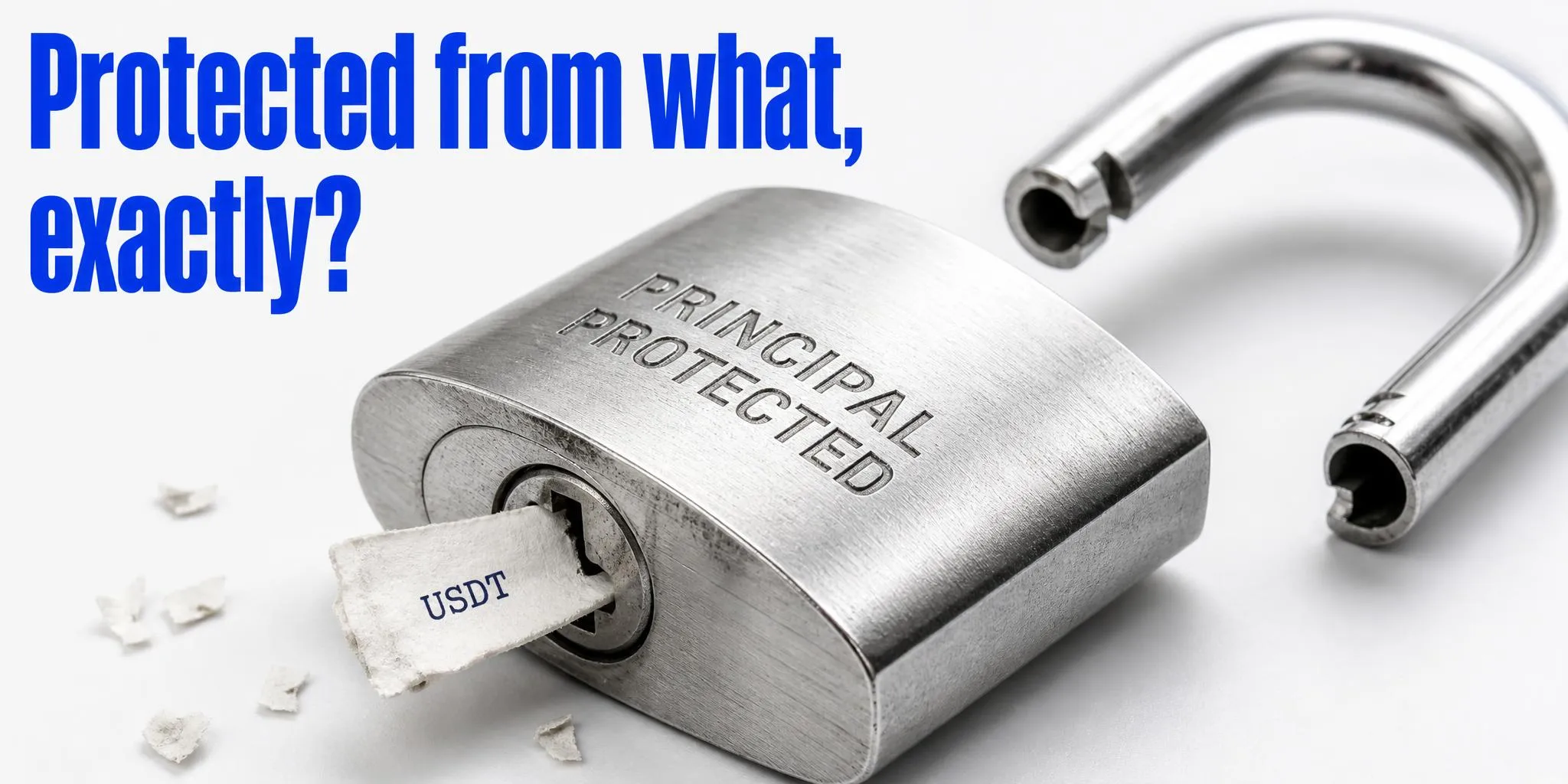
Principal Protected USDT Earn: What It Covers and What It Doesn't
Contents
You’re comparing USDT yield products and keep seeing the same phrase: “principal protected.” It sounds reassuring—something that keeps your original deposit safe no matter what.
The problem is that in crypto, “principal protected” doesn’t have a single legal or regulatory definition the way it might in traditional finance. Two products can use the exact same words while promising completely different things. One might mean you’ll get back the same number of USDT tokens you deposited. Another could mean the provider aims to cover your deposit under its own internal terms, as long as nothing catastrophic happens to the platform, the stablecoin, or the underlying strategy.
Neither version says anything about what those USDT will actually be worth in dollars when you get them back.
This article unpacks the claim into four questions you can apply to any product—centralized or onchain—so you can judge what’s actually being promised, who’s promising it, and what’s left out.
Quick Answer: What “Principal Protected” Actually Means
In traditional finance, principal protection usually refers to a structured product where a bond component is designed to return your initial investment at maturity, backed by the issuer’s credit. The U.S. Securities and Exchange Commission notes that such protection depends entirely on the issuer’s ability to pay—and that you could lose everything if the issuer defaults (SEC.gov).
In crypto, the phrase is borrowed from that world but rarely carries the same structure. There’s typically no zero-coupon bond, no regulated issuer, and no maturity date. Instead, “principal protected” in a stablecoin yield product is a marketing term that signals the product’s intent to avoid losing your deposited tokens. It is not:
- A guarantee backed by deposit insurance
- A promise that your USDT will hold its dollar peg
- Proof of segregated reserves or an external guarantee
- A claim that you can withdraw instantly under all conditions
The core message: the phrase is a starting point for questions, not a conclusion. To make it useful, you have to break it apart.
The Four Questions Behind Any Principal Protection Claim
Whenever a product says “principal protected,” treat it as an invitation to ask four specific questions. The answers vary from product to product—and those differences matter more than the label itself.
1. Protected by Whom?
Someone or something has to honor the promise. That entity could be:
- A centralized exchange or lending platform – you hold an account; they owe you the balance under their terms of service.
- A smart-contract system or protocol – the code enforces the rules; there’s no company obligated to make you whole if the code fails.
- An issuer of a structured note or token – a specific legal entity promises repayment, but its creditworthiness is what backs that promise.
FINRA warns that the protection guarantee is only as reliable as the financial institution that issues it (FINRA). If the institution fails, the guarantee may be worthless. In crypto, the same principle applies, but the entity might be an offshore exchange, a DAO, or a set of smart contracts with no legal recourse at all.
2. Protected in What Unit?
This is the most overlooked question, and it’s the one that can hurt the most. A product that returns exactly 1,000 USDT has protected your token-denominated principal. It has done nothing to protect the dollar purchasing power of those tokens.
USDT itself can lose its peg to the dollar. That’s a stablecoin-depeg risk, and no yield product’s “principal protection” covers it unless the product explicitly says so—which almost none do. Token-amount protection is not the same as fiat-value protection.
3. Protected Against Which Loss Mechanism?
Losses can come from many directions:
- Strategy losses – the yield-generating strategy loses money.
- Counterparty default – an exchange, custodian, or venue fails to meet obligations.
- Smart-contract exploit – a bug or attack drains funds.
- Stablecoin depeg – USDT loses its dollar value.
- Operational failure – the provider mismanages funds or goes insolvent.
A product that protects against strategy losses may still expose you to every other risk on that list. Protection is always specific to a particular loss mechanism. Unless the documentation names which ones are covered—and which ones aren’t—the word is hollow.
4. Under What Redemption or Withdrawal Conditions?
Principal can be “protected” while access is heavily constrained. You might be able to get your money back in principle, just not when you need it.
Common restrictions include:
- Redemption windows that open only periodically
- Caps on how much can be redeemed at once or per day
- Processing delays measured in days, not minutes
- Early-exit penalties that reduce what you receive
- Liquidity conditions that suspend redemptions entirely
The Canadian securities regulator puts it bluntly: PPNs guarantee your principal only if you stay invested until maturity—sometimes up to 10 years (GetSmarterAboutMoney.ca). Crypto products rarely have maturities that long, but lockups, withdrawal fees, and liquidity gates can create the same effect.
What “Principal Protected” Does Not Tell You
The phrase is narrow. It says nothing about several risks that matter just as much to your outcome.
It Is Not Deposit Insurance
In traditional banking, “protected” can mean FDIC insurance up to $250,000—backed by the government, with a clear resolution process. No stablecoin yield product offers that. Don’t let the language blur the line.
It Is Not an External Guarantee
A product’s internal promise to return your principal is only as strong as the entity making that promise. Unless an independent third party—an insurer, a segregated reserve fund, a bankruptcy-remote structure—explicitly backs the claim, you’re holding the provider’s credit risk.
It Does Not Mean the Yield Is Protected
APR and APY can drop sharply without violating a principal-protection promise. Yield protection and principal protection are two entirely separate questions. A product that returns 100% of your deposit but pays zero yield for six months has honored its principal claim while disappointing you on returns. That is not a breach—it’s how the terms work.
It Is Not Proof of Independent Audit
Unless a product’s documentation references a specific, published audit by a named firm—and that audit covers the principal-protection mechanism specifically—assume the claim is unaudited marketing. The structured-notes industry shows how even regulated products can contain fees and structural risks that aren’t obvious from the headline (ClassLawGroup.com). Crypto adds less regulatory oversight on top.
A Comparison Table: How the Same Claim Can Mean Different Things
To show how widely “principal protected” can vary, here are three stylized examples drawn from real product categories. These are illustrative, not reviews of specific named products, and they’re designed to show the diversity of the term.
Scenario A: A centralized exchange’s USDT flexible savings product, labeled “principal protected”
| What’s promised to be protected? | The USDT balance credited to your account |
|---|---|
| In what unit? | USDT tokens (1 USDT = 1 token in your account) |
| Who is responsible? | The exchange, under its terms of service |
| Risks outside the protection | USDT depeg, exchange insolvency, account freeze, withdrawal suspension |
| What can delay or restrict redemption? | Platform-level halts, KYC re-verification, maintenance windows, large-redemption review |
| What evidence can the user verify? | Only what the exchange chooses to publish; no onchain proof of reserves or strategy positions for that specific product |
Scenario B: An onchain delta-neutral protocol that wraps user deposits into a yield-bearing token
| What’s promised to be protected? | The net asset value backing the yield-bearing token, designed to stay at or above 1 USDT equivalent |
|---|---|
| In what unit? | USD-equivalent value, derived from strategy positions marked to market |
| Who is responsible? | Smart contracts and the protocol’s strategy engine; the user holds the token in their own wallet |
| Risks outside the protection | Smart-contract exploits, oracle errors, liquidation cascades, funding-rate reversals, venue failure |
| What can delay or restrict redemption? | Onchain congestion, liquidity buffer depletion, large-redemption slippage, strategy unwind time |
| What evidence can the user verify? | Onchain positions, backing ratio, reserve composition, recent strategy performance—all observable through block explorers and dashboards |
Scenario C: A structured note with “100% principal protection” issued by a regulated bank, held to maturity
| What’s promised to be protected? | The initial investment in dollars, repaid at maturity |
|---|---|
| In what unit? | Fiat currency (e.g., U.S. dollars) |
| Who is responsible? | The issuing bank—protection is a credit obligation of that institution |
| Risks outside the protection | Issuer default, inflation eroding purchasing power, opportunity cost |
| What can delay or restrict redemption? | The structure must be held to maturity; early exit may mean losses well below par |
| What evidence can the user verify? | The issuer’s credit rating, public financial statements, regulatory filings |
No one structure is categorically better. The table exists to show that you can’t compare two “principal protected” products without running them through the same columns.
Common Mistakes When Evaluating Principal-Protected Claims
Mistake 1: Assuming “Protected” Means “Risk-Free”
The phrase describes a specific design goal—returning your principal under certain conditions. It does not describe a product that cannot fail. The SEC, FINRA, and investor-education sites all emphasize this point for traditional PPNs, and it applies at least as strongly in crypto.
When someone says “principal protected,” ask immediately: protected from what, by whom, and under what conditions?
Mistake 2: Confusing Token Return with Dollar Return
Getting back 1,000 USDT is not the same as getting back $1,000. If USDT trades at $0.97, a full token return still means a 3% loss in purchasing power. Products that report exclusively in token terms make this distinction easy to miss. If dollar-value stability matters to you, you’ll need to manage stablecoin risk yourself—no yield product’s principal protection covers it.
Mistake 3: Ignoring Who Actually Owes You the Money
A common pattern: a platform says your deposit is “protected,” but the entity running it is an unregulated offshore company with no public financials. If that entity disappears, your principal protection evaporates with it.
Ask whether the responsible entity is a regulated institution with public credit data, a smart-contract system you can inspect, or an opaque corporate structure. The label doesn’t answer that—you have to look it up.
Mistake 4: Assuming Protection Means Instant Access
Protected principal doesn’t mean liquid principal. Redemption bottlenecks—gates, caps, processing delays, settlement times, strategy unwinds—can trap your funds for days or longer even while the protection claim itself remains technically intact. If you might need the USDT on short notice for payments or transfers, liquidity matters as much as protection.
Mistake 5: Treating the Yield as Part of the Safety Promise
A 10% APY next to “principal protected” can create an illusion that the entire package is safe. The yield is a separate variable, drawn from a strategy that can underperform or fail without violating the principal claim. If the advertised rate drops close to zero, the product’s core promise hasn’t been broken—you just got less (or no) return.
A Practical Due-Diligence Checklist
If you’re evaluating a USDT savings or yield product that uses the phrase “principal protected,” here’s what to verify before treating the claim as meaningful.
1. What do I get back if everything works as designed?
- Is it the same number of USDT, or an equivalent dollar amount?
- Does the documentation define the unit of account clearly?
2. Could the returned token itself lose dollar value?
- USDT depeg risk exists above and beyond any product’s protection promise.
- If the stablecoin breaks its peg, your returned tokens are worth less no matter what the product intended.
3. Who legally or technically owes me the principal?
- A named legal entity? A smart contract? A protocol DAO?
- Can you find that entity’s jurisdiction, financial condition, or track record?
4. What happens if the provider, strategy, issuer, or smart contract fails?
- What are the documented failure modes?
- Is there a recovery mechanism, an insurance fund, or a collateral pool—or is it entirely the provider’s ability to pay?
5. Can I redeem at any time, or only under specific limits or windows?
- Are there lock-up periods, notice requirements, daily caps, or early-exit penalties?
- What conditions can suspend redemptions?
6. Is protection backed by a contractual promise, collateral, reserve, insurance, or only product terms?
- A contractual promise from a creditworthy issuer is different from a strong intent stated in a whitepaper.
- External backing matters; internal promises are simply a bet on the provider.
7. Where is that protection documented?
- Terms of service? A published legal prospectus? A smart-contract address?
- If you can’t find the answer in writing, the answer doesn’t exist.
Run every product through these seven questions. The ones that hold up are the ones where you can answer most of them clearly and where the documentation aligns with what’s observable.
What About Products That Let You Inspect What’s Happening?
This is where the structure of a product starts to matter more than its labels. Some yield products—particularly centralized ones—ask you to trust the provider’s word that the principal is protected. You can’t see the strategy, the reserves, or the liabilities. The protection is a balance-sheet promise from a company you may know little about.
Other products operate onchain. The underlying strategy positions, the assets backing user deposits, the liquidity reserves, and the current supply of the yield-bearing token can all be observed directly through block explorers and real-time dashboards. That doesn’t make them safer—smart-contract risk, peg risk, strategy risk, and liquidity risk all remain. But it does shift the nature of your due diligence. Instead of asking “do I trust this company?,” you’re asking “can I see what’s happening, and does the evidence match the claim?”
Neither model is universally better. The onchain model replaces some counterparty risks with different risks—code exploits, oracle failures, governance attacks—and gives you tools to verify what’s happening yourself. The centralized model gives you a single point of responsibility and (sometimes) legal recourse, at the cost of transparency.
The decision framework often comes down to a trade-off: relying on an institution’s promise and balance sheet, or relying on a transparent system where you can verify positions but must accept technical risks. There is no single right answer for everyone. For a deeper breakdown of how custody choices change the risk profile in USDT savings products, you can explore the USDT custody and risk comparison here.
For more on what strategies can actually lose stablecoin deposits and how principal loss happens in practice, see the guide on USDT staking and Earn risks. And if you’re trying to decide between locking up USDT for higher rates or keeping it flexible, the Flexible vs Fixed USDT Earn comparison walks through the liquidity trade-offs.
FAQ
Is any principal-protected crypto product truly guaranteed?
No. The word “guarantee” requires an entity with the legal obligation and financial capacity to honor it. In crypto, even products that use the phrase “principal guaranteed” rarely name a regulated guarantor or an insured reserve. These are almost always product-level promises, not external guarantees. Traditional PPNs carry issuer credit risk; crypto products carry that plus additional layers of smart-contract, depeg, and platform risk.
What’s the difference between “principal protected” and “principal guaranteed”?
In traditional finance, “guaranteed” usually implies a formal obligation—an insurance wrapper, a government backstop, or a contractual guarantee from a rated entity. “Protected” is softer and often describes the structure’s design goal. In crypto, the terms are used almost interchangeably and neither carries a standardized meaning. Treat them as equivalent: both require you to ask the four questions outlined above.
Do any USDT savings products offer true principal protection?
Some products are structurally designed to avoid losing your deposited token amount. However, “true” principal protection, in the sense of an externally guaranteed, legally enforceable, all-weather promise, doesn’t really exist in the stablecoin yield market today. While certain designs have aimed to maintain token-denominated principal through market-neutral strategies and observable backing, past performance is not a guarantee of future results. There are products where you rely on the provider’s word and balance sheet, and products where you rely on smart-contract code and onchain verification. Both can fail in ways the label doesn’t cover.
What risks still exist even with a principal-protected stablecoin product?
Plenty. Stablecoin depeg risk is at the top: if USDT loses its dollar peg, your returned principal is worth less regardless of the product’s intent. Smart-contract risk, platform insolvency, counterparty defaults, liquidity freezes, redemption restrictions, and strategy underperformance can all hit your outcome without necessarily violating a narrowly defined principal-protection claim.
Is there a simple question I can ask to cut through the marketing?
Yes. Ask this: “What exactly do I get back under worst-case conditions, in which unit, from whom, and when?” If the product documentation can’t answer that clearly, the principal protection claim is adding noise, not information.
The Only Decision Rule That Matters
Stop evaluating products by whether they say they’re principal protected. Start evaluating them by whether you can answer the seven questions on the checklist above—and whether the answers hold up to scrutiny.
A claim that survives those questions is useful, whether the product is centralized or onchain. A claim that falls apart under them was never anything more than a marketing phrase.
Look for evidence, not adjectives.
Disclaimer
This article is for informational purposes only and is not financial, investment, legal, or tax advice. Crypto products, stablecoins, on-chain protocols, and yield-bearing tokens involve risk, including possible loss of funds. USDRL is designed to be USDT-pegged and yield-bearing, but peg stability, yield, liquidity, and redemption are not guaranteed. Always do your own research, understand the risks, and never deposit more than you can afford to lose.