TRUSD Renamed to USDRL: What the Token and Name Mean
Contents
If you have been following Reinforce, you might have noticed the token ticker looks different. You are likely here because you saw “USDRL” where you expected to see “TRUSD” and want a clear, unambiguous answer about what has changed. No fluff, no announcement fanfare.
Here is the update:
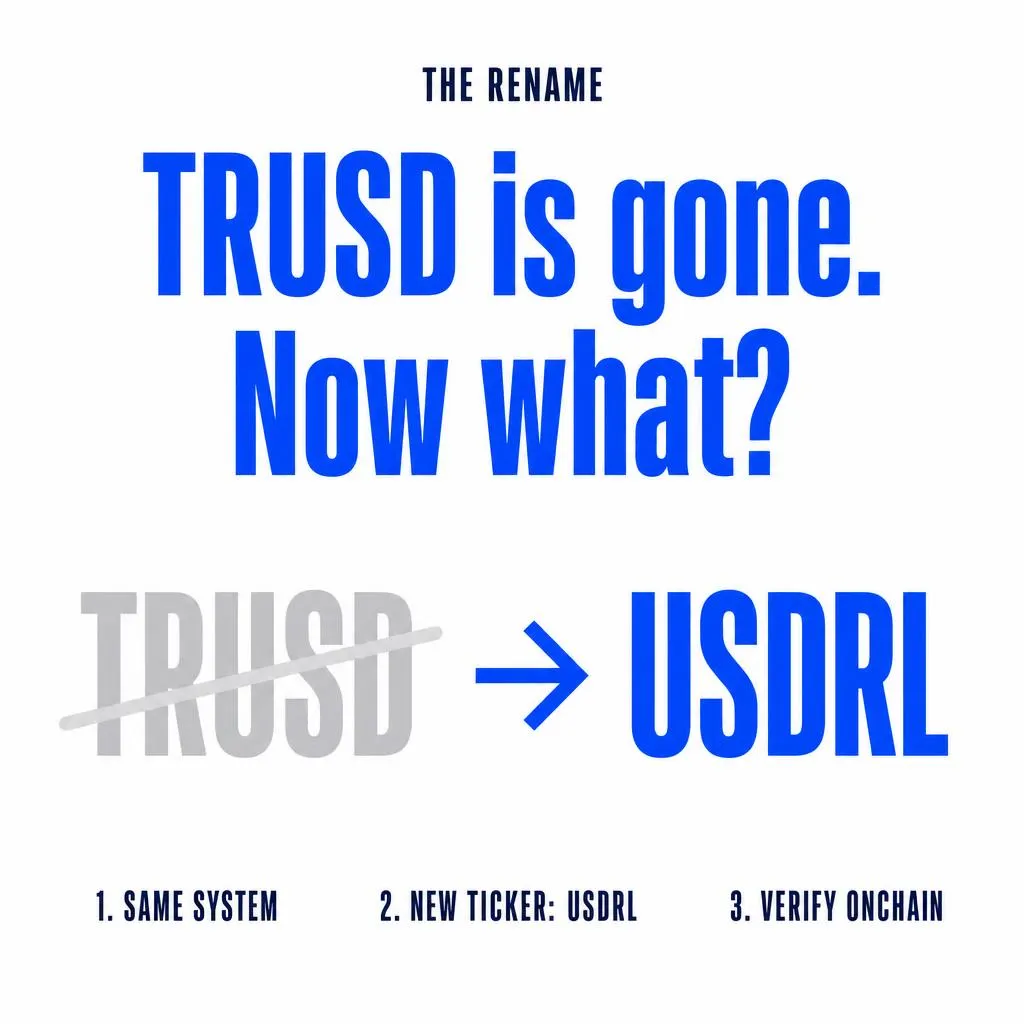
- TRUSD is the previous name and ticker.
- USDRL is the new, current, and sole official ticker going forward.
- The name USDRL is built from USD + Reinforcement Learning.
That is the change. The token itself, and the system that issues it, remains the same Reinforce product you have been researching.
What is the TRUSD token? (The previous name)
Before the rename, the token users received after depositing USDT into Reinforce was called TRUSD. It stood for Token Reinforced USD.
TRUSD has always been a separate yield-bearing onchain dollar issued by Reinforce. It is not a receipt. It is not an IOU. It is a distinct token designed to be redeemable back to USDT.
Historically, TRUSD represented two things:
- A claim on the underlying Reinforce system.
- A token designed to accrue variable yield generated by the strategy allocation and execution engine.
If you are reading older materials, community posts, or documentation that still reference TRUSD, treat that as the former name. All current and future official Reinforce communications use the new ticker.
USDRL meaning in crypto: Why the name changed
So what does USDRL mean in crypto? The new ticker is constructed from:
USD + Reinforcement Learning (RL)
The naming logic is intentionally straightforward. It connects two facts about the token:
- USD — The token is dollar-denominated. It lives in the stablecoin ecosystem, where users think in terms of US dollar value.
- Reinforcement Learning — Reinforcement learning and automated systems are the optimization layers Reinforce uses to improve decisions such as allocation, timing, venue selection, execution, position sizing, and hedge management.
An important distinction: Reinforcement learning is not the source of yield. The economic return comes from market opportunities captured by the underlying strategies — which can include delta-neutral funding-rate and basis opportunities, stablecoin lending, market-neutral execution, and cross-venue allocation. The AI and RL systems are the optimization engine that helps decide where and how to deploy capital. They are not a magic money printer.
Why rename now? The team decided that a ticker explicitly referencing the core technology — reinforcement learning — makes the token’s identity clearer. “TRUSD” described the token’s function (Token Reinforced USD). “USDRL” describes the token’s architecture: a dollar-denominated instrument optimized by reinforcement learning.
TRUSD to USDRL rename: What it means for you
If you are a token holder, or someone considering the product, this rename is a terminology update. It is not a new token, a migration, a redenomination, or a token swap.
Practically, here is what changes:
- What you search for: Look for USDRL in block explorers, dashboards, and price feeds.
- What you see in your wallet: The token ticker may update to USDRL, depending on the wallet interface.
- What you read: Official Reinforce channels now use USDRL exclusively.
Here is what does not change:
- The token’s core function: it is still the yield-bearing onchain dollar you receive after depositing supported USDT.
- The redemption path: USDRL is still designed to be redeemable back to USDT.
- The self-custodial flow: you still hold USDRL in your own wallet, you keep control of your private key, and you approve transactions yourself.
- The yield mechanism: variable, not guaranteed, and driven by underlying strategy performance — not by the ticker.
Common mistakes to avoid during the rename
Rename transitions can be confusing. Here are the specific things to watch out for:
- Don’t assume USDRL is a new token. It is the same token with a new name. If someone offers to “swap your old TRUSD for the new USDRL token,” that is likely a scam.
- Don’t search for TRUSD and expect current data. Price aggregators, block explorers, and dashboards will reflect the new ticker. Historical TRUSD data may persist on some sites (like CoinGecko), but that data reflects the same token now called USDRL.
- Don’t treat the name change as a product upgrade. The rename does not signal a change in backing, yield, liquidity, or redemption mechanics. Those remain governed by the same protocol design and market conditions.
- Don’t confuse this with a redenomination or airdrop. There is no new token to claim, no multiplier, and no snapshot.
The full flow: USDT → USDRL → USDT
Since you are researching the product, it helps to see how the token fits into the actual user flow. The rename does not change these steps; it only changes the ticker that appears at step two.
Step 1: Deposit USDT You connect your own wallet and deposit supported USDT into Reinforce. Reinforce does not receive your private key. You approve the transaction yourself.
Step 2: Receive USDRL You receive USDRL — the new ticker for the token formerly called TRUSD. This is a separate yield-bearing onchain dollar issued by Reinforce. It sits in your wallet. You control it.
Step 3: USDRL is designed to accrue variable yield Behind the scenes, the Reinforce strategy system allocates capital across onchain opportunities. The yield is variable and not guaranteed. USDRL is designed to reflect that value accrual over time.
Step 4: Redeem back to USDT You initiate a redemption, and the system is designed to return USDT to your wallet. Redemption timing is not guaranteed to be instant under every condition. It can depend on liquidity, network conditions, routing, and strategy unwinds.
This is the same flow that existed under the TRUSD name. The renaming to USDRL touches none of the mechanics.
What USDRL is not
An article that only praises a product reads like an ad. Here is where the line is drawn plainly:
- USDRL is not USDT. It is a separate token issued by Reinforce. You are exchanging one asset for another when you deposit, and you carry the risks of the USDRL token — including smart-contract risk, peg or de-peg risk, and redemption risk.
- USDRL is not a guaranteed redemption instrument. The token is designed to be redeemable back to USDT, but the timing and liquidity are subject to protocol conditions.
- USDRL is not a bank deposit or a centralized exchange Earn account. It is an onchain token. You hold it in self-custody. That means you control the key, but you also carry the responsibilities of self-custody — including protecting your seed phrase and approving transactions carefully.
- Reinforcement learning is not a yield source. It is an optimization layer. The economic return comes from market strategies, which carry their own risks: smart-contract, venue, liquidity, execution, hedge, model, operational, and market-structure risks.
How to verify the new name yourself
The authoritative source is the official Reinforce naming decision. If you want to confirm this update independently, check the following official channels:
- The Reinforce website at reinforce.fi
- The project whitepaper at reinforce.fi/whitepaper
- The official blog at reinforce.fi/blog
Any official communication from Reinforce should now use USDRL as the sole ticker. If you see a channel still using TRUSD, it is likely outdated or unofficial.
Frequently asked questions
Is TRUSD the same as USDRL?
Yes. USDRL is the new name for the same token. No migration, swap, or action is required from holders.
Do I need to do anything with my TRUSD tokens?
No. If you hold TRUSD in your wallet, those tokens are now referred to as USDRL. There is no claim process, no swap deadline, and no action needed.
What does the “RL” in USDRL stand for?
Reinforcement Learning. It refers to the optimization technology Reinforce uses to improve strategy allocation, execution, and risk management decisions.
Will the token contract address change?
This rename is a ticker and naming update. The brief does not introduce a new contract address. For the current and correct contract address, refer to the official Reinforce documentation.
Where can I see the current USDRL supply, backing, and performance?
Reinforce publishes proof-oriented information — including supply, backing, strategy allocation, and recent performance — through its official dashboards and documentation. Start at reinforce.fi.
What risks should I keep in mind with USDRL?
USDRL carries smart-contract risk, peg risk (the token may trade below or above its intended value), redemption risk (conversion back to USDT may be delayed or limited by liquidity conditions), and the inherent risks of the underlying strategies. Yield is variable and not guaranteed. Self-custody means you are responsible for your wallet and private key.
Same Reinforce. New ticker: USDRL.
To explore how USDRL fits into the full Reinforce product — and to review the current backing methodology, yield sources, and redemption mechanics — visit the official site and documentation.
Disclaimer
This article is for informational purposes only and is not financial, investment, legal, or tax advice. Crypto products, stablecoins, on-chain protocols, and yield-bearing tokens involve risk, including possible loss of funds. TRUSD is designed to be USDT-pegged and yield-bearing, but peg stability, yield, liquidity, and redemption are not guaranteed. Always do your own research, understand the risks, and never deposit more than you can afford to lose.