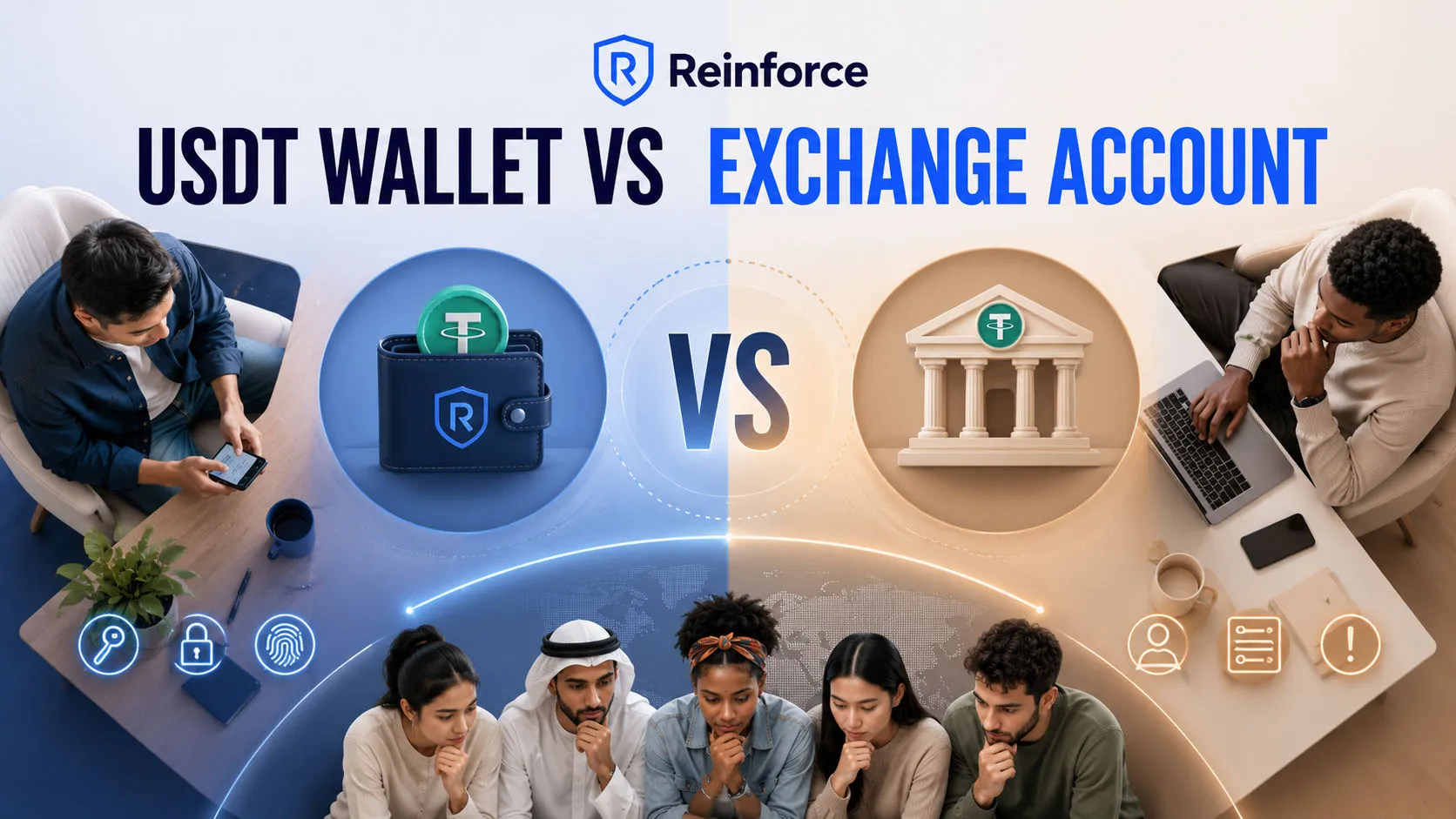
USDT on an Exchange vs Wallet: Who Actually Controls Your Funds?
Contents
Quick answer: if your USDT is on a centralized exchange, the exchange controls the private keys and processes withdrawals. If your USDT is in a self-custody wallet, you control the key and authorize transactions yourself.
That does not make one model universally safe and the other unsafe. They fail in different ways. And USDT still has token-level issuer controls regardless of where you hold it.
The useful question is not just “where is my USDT?” It is:
Who can authorize a transaction, who can block access, and what happens if something goes wrong?
A custodial wallet is managed by a service on your behalf. A non-custodial or self-custody wallet lets you control account authorization. Check the actual account design: smart-contract wallets, multisignature accounts and recovery arrangements can add permissions beyond a single seed phrase.
The same balance can represent two different things
An exchange dashboard may show “1,000 USDT.” A wallet app may also show “1,000 USDT.”
Those numbers can look identical while the ownership mechanics are very different.
On an exchange, your balance is generally an internal platform record representing what the exchange owes you. The exchange manages the blockchain wallets and private keys.
In a typical key-controlled self-custody account, USDT is recorded at a blockchain address whose transactions you authorize. Other wallet designs can use different signing or recovery rules.
What you control on an exchange
With a centralized exchange:
- the exchange holds the private keys;
- the exchange processes withdrawals;
- account access depends on login, security controls, and platform status;
- withdrawals may be limited, reviewed, or paused;
- the platform usually provides account recovery and customer support.
That can be convenient for trading, P2P, conversion, and users who do not want to manage seed phrases.
The trade-off is counterparty dependence.
What you control in a self-custody wallet
With a self-custody wallet:
- you hold the private key or seed phrase;
- you approve transactions yourself;
- there is no exchange-level withdrawal approval;
- there is no central party that can reset a lost private key.
You gain direct control over transaction authorization, but you also take direct responsibility for backups, phishing protection, network selection, and address verification.
One important correction: key control is not total control over USDT
For the issuer-level layer, review Tether’s current legal documentation. The key point is that wallet-key control and token-issuer controls are separate.
USDT is an issuer-managed token. On supported networks, the token contract can include issuer-level controls such as address restrictions.
So this statement is too broad:
“If I hold the key, no third party can ever affect my USDT.”
A better mental model is:
wallet key control = control over wallet authorization, not control over every rule of the token or network.
Exchange vs wallet comparison
| Question | Centralized exchange | Self-custody wallet |
|---|---|---|
| Who holds the private key? | Exchange | You |
| Who processes withdrawals? | Exchange | You sign onchain |
| Account recovery | Usually available | No central reset |
| Exchange account restrictions | Possible | Not applicable at account layer |
| Token issuer controls | Still apply | Still apply |
| Main operational risk | Platform/counterparty | User/key management |
| Onchain transparency | Limited for your specific balance | Address is directly inspectable |
Risks specific to exchange custody
Counterparty risk
If the exchange becomes insolvent or faces a major operational failure, access to balances can be affected.
Account restrictions
Compliance or security reviews can delay withdrawals even when the balance is visible.
Platform hacks
Centralized exchanges concentrate assets and infrastructure, making them attractive targets.
Policy changes
Withdrawal limits, supported networks, and product terms can change.
Risks specific to self-custody
Lost seed phrase
If you lose your recovery method and device access, there may be no recovery path.
Phishing
Fake wallet sites, malicious apps, and fake support can steal credentials or trick you into signing harmful transactions.
Wrong network or address
Blockchain transfers are often irreversible. A valid-looking address does not guarantee the receiver supports the selected network.
Malicious approvals
Smart-contract interactions can grant permissions that survive until revoked.
Risks shared by both models
Custody is only one layer.
Both models still face:
- USDT issuer-level risk;
- depeg risk;
- blockchain congestion;
- network fees;
- service or integration failures;
- phishing and social engineering.
So which model is better?
There is no universal answer.
A user who trades or uses P2P frequently may value exchange convenience and account recovery.
A user who values direct key control may prefer self-custody and accept the responsibility that comes with it.
The decision is better framed as a trade-off between control, convenience, recovery, and failure modes.
What changes when you add yield?
For concrete examples, compare Aave’s supply documentation with Morpho’s vault asset-flow documentation. These show how self-custody at the wallet layer can coexist with assets being deployed into protocol contracts.
Once USDT enters an Earn or savings product, there is another layer to analyze.
With CEX Earn, the exchange still controls custody while the funds are used according to the product’s internal model.
With onchain yield, you may keep control of your wallet key while the underlying USDT moves into a smart contract. You may receive a receipt token, vault share, or yield-bearing token.
That means “self-custody yield” does not necessarily mean the original USDT remains idle at your address.
A contextual example: Reinforce
For product-specific mechanics, see How Reinforce Works and What Is USDRL?.
Reinforce is a self-custodial onchain savings product for USDT holders, with an initial focus on TRC-20 USDT.
Users connect their own wallet, deposit supported USDT, and receive USDRL — a separate yield-bearing onchain dollar issued by Reinforce and designed to be redeemable back to USDT.
The user keeps control of the wallet key and approves transactions. The underlying system introduces smart-contract, strategy, liquidity, execution, peg, and redemption risks. Yield is variable and not guaranteed.
This is a different custody model from CEX Earn, not a risk-free version of it.
Check access before you need the funds
For a platform balance, inspect withdrawal availability, account restrictions, the supported network and the amount that would reach your destination. For a self-custody balance, check the account, backup method and resources needed to send.
Use the USDT receiving guide before a transfer. If access is already blocked, the wallet-freeze guide separates issuer restrictions, custodial controls and technical errors.
If you are considering yield, compare the USDT earning models before treating a position token as spendable USDT.
A practical comparison framework
Before deciding where USDT belongs, ask:
- What is the USDT for — trading, payments, savings, or working capital?
- How important is direct key control?
- Do I need account recovery?
- Am I comfortable managing a seed phrase?
- How quickly do I need to move the USDT?
- If yield is involved, where does the yield come from?
- What do I hold while earning?
- How do I get back to usable USDT?
FAQ
Is a crypto exchange the same as a wallet?
No. An exchange can provide a custodial wallet interface, but the exchange controls the private keys. A self-custody wallet puts key control with the user.
Is self-custody always safer?
No. It reduces exchange-custody dependence but increases user responsibility and can introduce smart-contract risk when used with onchain protocols.
Can USDT be restricted in a self-custody wallet?
USDT has issuer-level controls that are separate from who holds the wallet key.
What is the biggest difference?
Who controls transaction authorization: the exchange or the user’s private key.
Make the control trade-off explicit
Do not compare “exchange” and “wallet” as simple safe/unsafe labels.
Compare key control, access, recovery, token-level controls, and the risks you take on in each model.
Disclaimer
This article is for informational purposes only and is not financial, investment, legal, or tax advice. Crypto products, stablecoins, on-chain protocols, and yield-bearing tokens involve risk, including possible loss of funds. USDRL is designed to be USDT-pegged and yield-bearing, but peg stability, yield, liquidity, and redemption are not guaranteed. Always do your own research, understand the risks, and never deposit more than you can afford to lose.