Where Does TRUSD Yield Come From? The Reinforce Mechanism
Contents
You hold USDT. You’ve seen the Reinforce dashboard, maybe read the one-pager. You understand the surface-level flow: deposit USDT, receive TRUSD, and over time TRUSD is designed to reflect some level of yield. What that one-pager usually skips is the moment you sit back and ask the obvious question: if I’m not trading and I’m not lending to a specific counterparty myself, who is paying this yield?
You are right to ask. A yield number without a named economic source is a marketing claim. A mechanism described as “AI-powered” without explaining what the model actually changes is a black box. You are not here for either one.
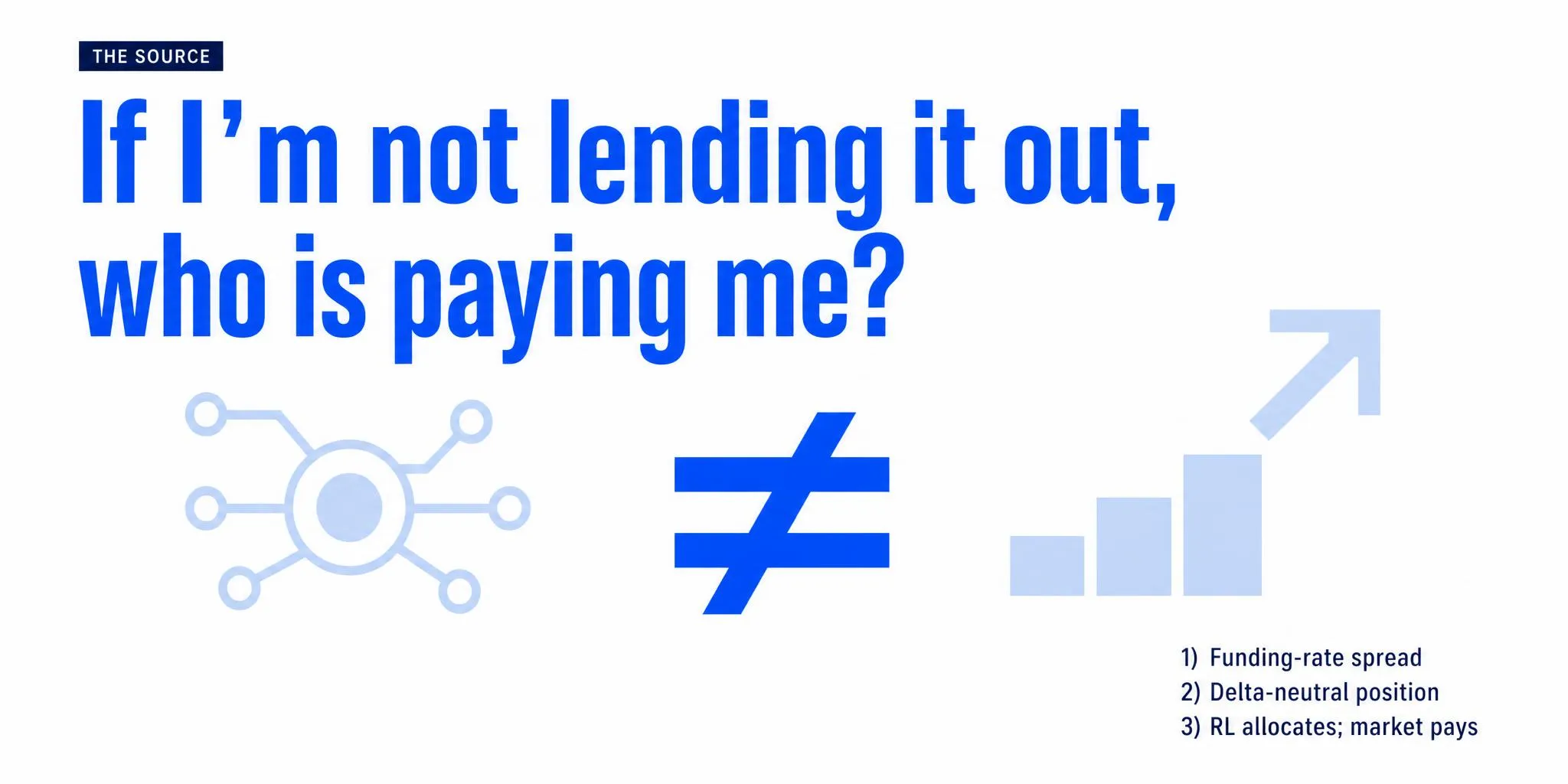
The direct answer is two layers: the economic source is a set of market-neutral strategies—primarily capturing funding-rate spreads and basis differences across trading venues—and the AI layer, which uses forms of reinforcement learning, does not create the return. The model decides where, when, and how much capital to allocate, and it manages execution and hedges. Yield comes from market participants paying for leverage and liquidity. The model’s job is allocation, signal processing, and risk management.
Here is the mechanism, component by component.
Where the yield actually comes from: the delta-neutral spread
Most of the return Reinforce captures is a spread between two linked markets that should converge. A common example is the funding rate in perpetual futures markets.
In a perpetual futures market, long and short positions pay each other a periodic funding rate to keep the contract price anchored to the spot price. When more traders want leverage to go long, longs pay shorts—and that funding rate can become significantly positive. A delta-neutral setup designed to capture that spread aims to earn the funding rate while the dollar value of the combined position remains roughly flat, net of execution and slippage.
That spread is the primary economic source. It is not created by Reinforce. It exists because leveraged traders on venues like centralized exchanges and some onchain derivatives protocols are willing to pay for exposure. Reinforce’s strategy infrastructure is designed to capture that spread systematically. Other related sources can include stablecoin lending pools, basis trades across different expiration futures or different venues, and cross-venue allocation—all variations on the same theme: earn a spread from markets that temporarily diverge, while keeping net directional exposure low.
None of these strategies are new. What changes is how they are managed.
How the spread becomes TRUSD yield
A user deposits USDT through Reinforce’s interface and receives TRUSD. Behind the scenes, the deposited USDT is deployed into a portfolio of the strategies described above. The returns from those strategies accrue to the system, and the value TRUSD reflects is designed to increase over time relative to the deposited USDT. When you redeem TRUSD back to USDT, the difference between what you put in and what you get out is the yield.
Two important points that often get collapsed together:
- Yield is variable and not guaranteed. Funding rates change. Spreads compress when more capital chases the same trade. A strategy that earned one rate last month will earn a different rate this month.
- TRUSD is not USDT. It is a separate yield-bearing onchain dollar issued by Reinforce and designed to be redeemable back to USDT. You hold the TRUSD in your own wallet, but the token’s value is linked to the performance of the strategies underneath.
What reinforcement learning actually does (and does not do)
Boil away the buzzwords, and reinforcement learning is a family of algorithms that learn which actions to take in which states to maximize some reward over time. In Reinforce’s context, that reward is not direct profit per trade; it is more likely a composite of risk-adjusted returns and execution quality across many small decisions.
Here is what the optimization layer is designed to influence:
- Venue selection. The same funding-rate trade might be available on three different exchanges with different rates, liquidity depth, and fee schedules. The model selects where to deploy.
- Position sizing and rebalancing timing. When spreads widen or narrow, the model decides how much capital to move and how quickly.
- Hedge management. Delta-neutral does not mean auto-pilot. The hedge ratio drifts, and the model adjusts it.
- Execution routing. Splitting a large order across venues and times to reduce market impact and slippage is a classic optimization problem.
What reinforcement learning does not do:
- It does not generate yield from nothing. The economic return is the spread; the model just captures more of it or captures it more consistently.
- It does not predict market direction. The strategies are market-neutral in design, so the model is not forecasting whether crypto goes up or down.
- It is not a black-box hedge fund. The strategies it optimizes are known categories—funding-rate capture, basis trades, lending—not opaque proprietary bets.
Think of it as an automated allocator that learns from market conditions and execution outcomes, rather than a crystal ball.
Comparing the layers: economic source vs. optimization technology
This distinction matters because a lot of yield product marketing collapses the two. A table makes it concrete:
| Layer | What it is | What it is not |
|---|---|---|
| Economic yield source | Funding-rate spreads, basis trades, stablecoin lending returns | Created by AI; a fixed promise |
| Optimization technology | Reinforcement learning and automated systems that allocate capital, select venues, size positions, and manage hedges | The origin of the return; a guarantee of better performance |
The yield can be healthy even with simple rules-based allocation. The reinforcement learning layer is designed to improve execution, react faster to changing spreads, and manage risk more dynamically than a static script would. That is a meaningful edge, but it is an operational edge on a known strategy type, not an alchemy.
What you can actually verify
Reinforce states that TRUSD is backed by observable onchain assets, including strategy positions and liquidity reserves. The team publishes proof-oriented data: TRUSD supply, backing composition, strategy allocation, and recent performance. The Reinforce whitepaper describes the architecture in detail, and the Reinforce blog may carry updates on methodology and metrics.
The right question to ask is not “is it backed?” but “backed by what, and how is the backing ratio calculated?”
A backing ratio compares the value of the tracked backing assets with the issued TRUSD supply. When Reinforce reports a backing ratio above 100%, that means, according to its stated methodology, the tracked assets exceed the issued supply. What you want to check:
- Which assets are counted in the backing calculation (strategy positions, idle reserves, receivables).
- How frequently that data is updated.
- Whether the methodology counts assets at current market value or at some other valuation.
- What is explicitly excluded.
Transparency here is the difference between trusting a number and understanding what the number means. The Reinforce website should be your first stop for current backing data.
Common mistakes when evaluating yield sources
Conflating the technology stack with the return source. The most common one. AI is impressive, and it is easy to let the model’s sophistication substitute for a real understanding of where the money comes from. If you cannot name the economic spread in one sentence, you do not understand the yield source yet.
Assuming market-neutral means low-risk or risk-free. Market-neutral strategies remove directional exposure—they are designed to profit whether the market goes up or down within a band. That eliminates one risk. It leaves others: smart-contract risk, venue failure, liquidity crunches during volatility, execution slippage, and the risk that the hedge drifts or fails under extreme conditions. A delta-neutral position is not a Treasury bill.
Treating the backing ratio as a solvency guarantee. A ratio above 100% says that the tracked assets exceed the tracked liabilities at that moment. It does not say that every asset is instantly liquid at that valuation, that no liabilities are off the reporting frame, or that the ratio cannot change rapidly. Backing data is an important transparency signal; it is not a promise.
Ignoring redemption constraints. Reinforce maintains liquidity and reserve capacity designed to support ordinary redemptions, but redemption timing is not guaranteed to be instant under every condition. Large redemptions, network congestion, or strategy unwind periods can affect how quickly you get back to USDT. Plan accordingly.
Confusing TRUSD with USDT. TRUSD is a separate token. It carries its own set of contract addresses, peg dynamics, and redemption path. Holding TRUSD in your wallet means you hold a yield-bearing instrument, not a direct IOU for the USDT you deposited. The distinction is not cosmetic; it determines what you own at each stage.
Questions users commonly ask about yield-bearing products
Questions any user might consider when evaluating a yield-bearing product like TRUSD include:
-
Can I explain the economic source in my own words? If the answer is “funding-rate spreads and basis trades,” you are on solid ground. If it is “AI does something complicated,” pause and re-read the mechanism section above.
-
Do I understand what I hold at each step? You deposit supported USDT, receive TRUSD in your wallet, and later initiate redemption to receive USDT back. During that middle period, you hold a yield-bearing token, not USDT, and its value is linked to strategy performance.
-
Have I checked the current backing and performance data? Visit the Reinforce site and look at the latest supply, backing, allocation, and performance metrics. Do not take a snapshot from a third-party aggregator as current.
-
Do I know what I am not exposed to, and what I am? You are not exposed to directional crypto market moves by design, but you are exposed to smart-contract risk, venue risk, liquidity risk, and execution risk.
-
Does my timeline match the redemption model? If you need same-day guaranteed access to every dollar of USDT, no yield-bearing structure can promise that—TRUSD included. Check the redemption conditions and expected timelines before committing capital you might need urgently.
FAQ
Does the AI guarantee better returns than manual strategies?
No. Reinforcement learning is designed to optimize allocation and execution quality over time, but it cannot guarantee any specific outcome. The underlying spreads the strategy captures exist in the market; the model tries to capture them more efficiently. Past improvements in execution quality do not tell you what will happen next.
How is this different from a centralized exchange Earn product?
In a typical CEX Earn product, you deposit assets into a custodial account and the exchange decides what to do with them, often with limited disclosure about the exact strategies, counterparties, and reserves. With Reinforce, you hold TRUSD in your own wallet, approve transactions yourself, and have access to onchain backing data and published strategy methodology. That said, each model carries its own risk set: self-custody means you bear more operational responsibility, and the redemption path depends on onchain liquidity rather than a centralized order book.
What happens if the funding rate turns negative for a sustained period?
The delta-neutral setup flips: shorts pay longs. In a negative-rate environment, a strategy that aims to capture the funding rate earns nothing or loses on the carry. The allocation model would aim to reduce exposure to that trade and rotate into alternatives like lending pools or cross-venue basis trades where available. Yield would compress or pause. This is why the variable-yield design matters—you are not promised a rate regardless of market conditions.
Can I see the model’s decisions in real time?
Not per-trade. What you can see is the resulting allocation and performance data the team publishes. The model’s specific venue selections, timing decisions, and position-sizing adjustments are proprietary operational details. The transparency is at the outcome level—aggregate strategy allocation, backing, supply—not the trade log.
Is the backing ratio the same as an insurance fund?
No. A backing ratio is a metric: the value of tracked assets divided by the value of issued TRUSD. An insurance fund is an explicit pool designed to absorb losses in specific failure scenarios. Backing data shows what assets are behind the token at a point in time; it does not create a claim on a separate loss-absorbing pool. Do not read one as the substitute for the other.
Yield is credible when you can name the economic spread, separate it from the technology that optimizes it, and check the numbers that describe it. Reinforce publishes the data; the remaining work is yours—read the methodology, check the current metrics, and know what you hold.
If you are ready to trace the full mechanism, the Reinforce whitepaper and current protocol data on the Reinforce website are the right next stops.
Disclaimer
This article is for informational purposes only and is not financial, investment, legal, or tax advice. Crypto products, stablecoins, on-chain protocols, and yield-bearing tokens involve risk, including possible loss of funds. TRUSD is designed to be USDT-pegged and yield-bearing, but peg stability, yield, liquidity, and redemption are not guaranteed. Always do your own research, understand the risks, and never deposit more than you can afford to lose.