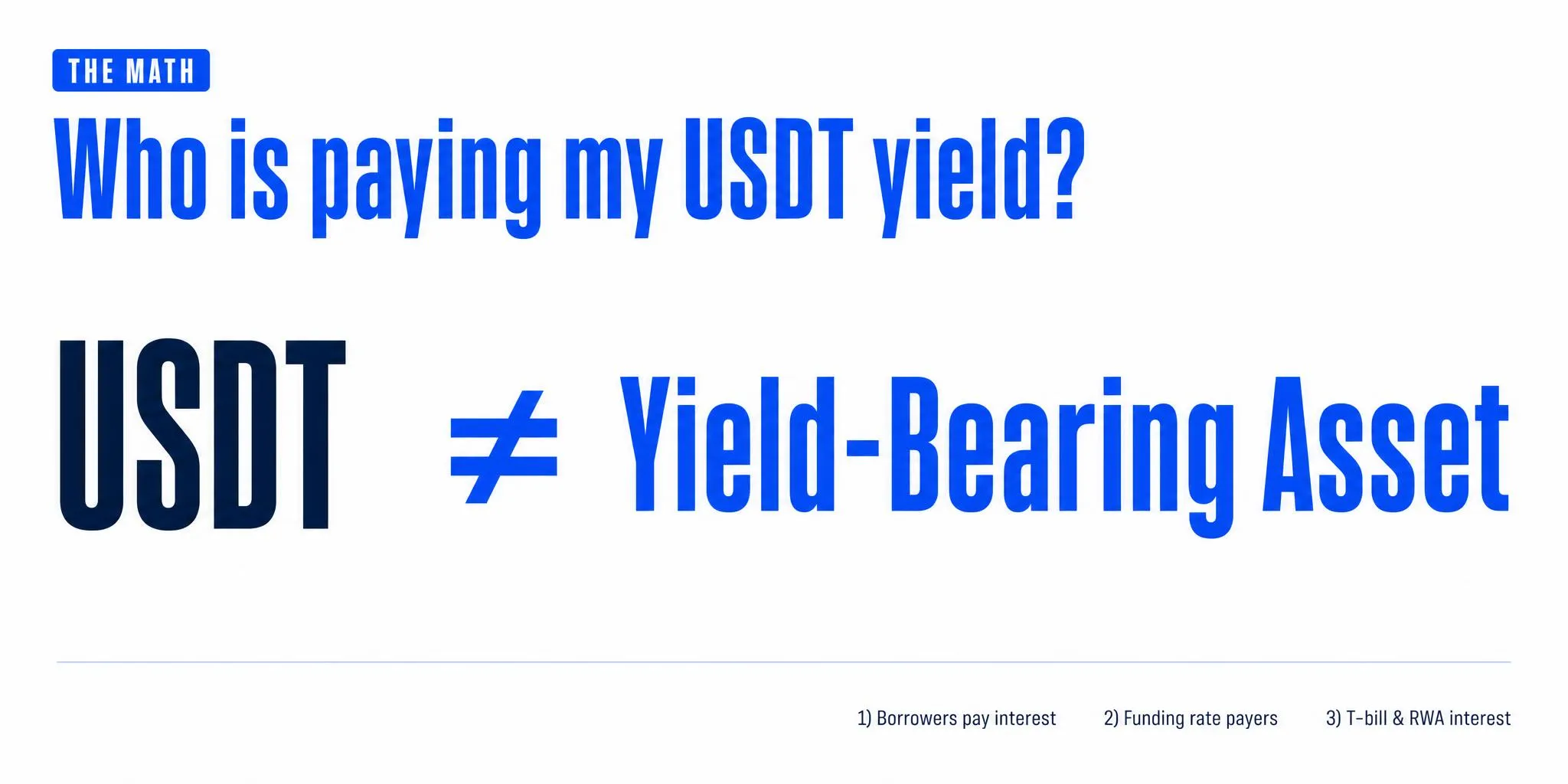
Where Does USDT Yield Actually Come From? Follow the Money
Contents
You hold USDT. You see a rate advertised—on an exchange Earn page, in a wallet app, or inside a DeFi vault. A number like 8%, 12%, or higher flashes on the screen, and the instinct is to compare that number against other numbers and pick the highest one.
That instinct is expensive. USDT does not generate native yield. It is a digital dollar peg, not a dividend-paying asset. Every return you see must trace back to a real economic payer, a subsidy, or both. The most useful mental model when you evaluate a yield product is to forget the wrapper—CEX Earn, wallet Earn, vault, yield-bearing token—and follow the money underneath it.
Quick answer: The most common payers behind USDT yield are (1) borrowers who pay interest for access to stablecoin liquidity, (2) perpetual-market participants who make funding-rate payments between long and short positions, (3) traders who pay swap fees captured by liquidity providers, and (4) traditional-debt interest from Treasury-bill or RWA holdings. Some displayed returns also contain protocol token incentives—money that is printed, not earned from a real payer—and those can disappear even if the underlying strategy remains healthy.
If you cannot complete the sentence “My yield is paid by ___ because ___” for a specific product, you do not yet understand it. This article walks through the sources one by one so you can.
Borrowers Pay Interest to Access Your USDT
The oldest and most direct source: someone borrows your USDT and pays you for the privilege.
Who pays? Margin traders, market makers, institutional liquidity desks, and overcollateralized DeFi borrowers. Why do they pay? The borrower needs stablecoin liquidity to execute a trade, hedge a position, or fund an arbitrage and is willing to pay interest for that access. What makes the rate rise, fall, or disappear? Borrowing demand drives the rate. When leverage is high and traders want more dollar liquidity, rates climb. When demand cools and pools sit underutilized, rates compress.
What risk do you inherit? You inherit the risk of the venue that intermediates the loan. On a centralized exchange, that is counterparty risk—the exchange faces your borrower and must stay solvent, operationally sound, and willing to honor withdrawals. In a decentralized lending protocol like Aave, you inherit smart-contract risk, utilization-model risk, and the possibility that collateral liquidations fail under extreme market conditions, creating bad debt.
The wrapper can look different while the economic source stays the same. A centralized exchange Earn product that describes itself as “Flexible Savings” may in fact be lending your USDT to margin traders and sharing some of the interest with you. OKX Simple Earn Flexible is a documented example of this: the product wrap is a simple deposit-and-earn interface, but the return derives primarily from lending assets to borrowers on the platform. The wrapper is convenience and UX—the economic payer is still the borrower.
On the onchain side, lending protocols match depositors with borrowers algorithmically. Aave’s supply mechanism illustrates the relationship clearly: the yield a supplier sees rises as the utilization rate (the share of deposited funds currently lent out) increases. When utilization is low, the rate is low. When utilization approaches its ceiling, rates can spike because the remaining liquidity is scarce. This is a true organic cash flow—borrower-paid, market-driven, variable—and not a subsidy.
The decision rule here: Before depositing into any lending-like product, ask whether you can see the utilization rate and the interest-rate model. A product that shows a headline APY but never exposes how much is lent, to whom, or at what rate, is asking you to trust a black box.
Perpetual-Market Participants Pay Each Other—You Can Try to Capture the Net
A second major source shows up in products labeled delta-neutral, market-neutral, or basis-yield.
What is happening? In perpetual futures markets, longs and shorts make periodic payments to each other to keep the contract price tethered to the spot price. This payment is called the funding rate. When more traders are long and the market is bullish, longs pay shorts. When sentiment flips, shorts pay longs.
A delta-neutral strategy tries to capture the net funding payment while hedging away directional price exposure. The operator opens a spot position and an opposing perpetual position of roughly equal size. Price moves on one leg are offset by the other, so the return comes mainly from the funding-rate flow—not from betting which way the market will move. Coinbase’s funding-rate documentation explains the basic mechanism: funding ensures the perpetual price does not drift too far from the index price, and the rate itself can change sharply depending on market sentiment.
Who pays? The other side of the perpetual market—longs or shorts, depending on the prevailing funding direction—pays the funding flow the strategy attempts to capture. Why do they pay? They pay to maintain their desired directional exposure without the contract deviating wildly from spot. What makes the rate rise, fall, or disappear? Funding is inherently unstable. It can compress to near zero in flat markets, surge during speculative euphoria, and even turn persistently negative, meaning an inappropriately positioned strategy pays out rather than receives.
What risk do you inherit? Market-neutral does not mean risk-free. You inherit execution risk (the hedge slips or the operator enters the trade at a disadvantageous basis), venue risk (the exchange where the perp sits freezes, fails, or censors activity), liquidity risk (exiting a large hedged position during stress can be expensive), and model risk (the automated system misjudges timing, sizing, or venue selection relative to a changing funding environment). You also inherit the reality that a strategy which worked at one scale or market regime may stop working when conditions shift.
A product that packages funding-rate capture as an always-on yield stream should be able to explain what it does when funding is low or negative. If that explanation is absent, the product is not ready for your scrutiny.
Traders Pay Swap Fees—Liquidity Providers Receive a Share
A third organic source sits inside decentralized exchanges.
How it works: Automated market makers like Uniswap use pools of paired assets to facilitate swaps. Every time a trader swaps one asset for another, they pay a small fee. That fee is distributed to liquidity providers (LPs) who deposited assets into the pool. Uniswap’s liquidity-provider fee explanation describes the mechanic simply: when you add liquidity, you earn a proportional share of the fees generated by the swaps that use the pool.
For stablecoin-stablecoin pairs—say, USDT/USDC—the main risk is not impermanent loss from price divergence (the assets are designed to stay near $1), though de-pegs can and do occur and can inflict sudden losses. The dominant risks are smart-contract risk, pool-solvency risk, and the reality that fee revenue depends on trading volume. When volume dries up, yield falls. When volume surges, yield can spike, but so can network congestion and slippage for LPs entering or exiting.
Who pays? The traders who execute swaps pay the fees. Why do they pay? They pay for the convenience and speed of an onchain swap, and the fee is the cost of using the liquidity you provided. What makes the rate rise, fall, or disappear? Trading volume and fee-tier settings. A pool on a high-traffic pair can generate meaningful fee APR during active markets and almost nothing during quiet periods.
Liquidity-provider fee yield is a real cash flow, but it is not a fixed-rate savings instrument. An LP position is a working capital position. It produces variable gross revenue before fees, gas, and the cost of rebalancing, and it can lose value during volatility events. Products that pool LP deposits and auto-manage the position shift some of that complexity onto an operator, but the underlying economic reality does not change: the trader is the payer, and the volume is the fuel.
Treasury-Bill and RWA Yield—The Economic Payer Is Traditional Debt
A fourth category has grown as protocols and products have routed stablecoin deposits into off-chain, yield-bearing instruments—most commonly short-duration US Treasury bills or repurchase agreements.
Who pays? The US government (via Treasury-bill interest) or, in the case of private credit and repo, the institutional counterparty that borrows the capital. Why do they pay? Because that is the interest rate demanded by the traditional-debt market. What makes the rate rise, fall, or disappear? The risk-free rate and credit spreads. When central-bank policy rates shift or credit conditions tighten, the yield available on new Treasuries or RWA instruments moves with them.
It is important to separate the asset from the stablecoin. Holding ordinary USDT in a personal wallet does not earn any Treasury yield. Tether Limited, the issuer of USDT, may hold reserve assets that produce income, but that income accrues to the issuer, not to the token holder. The only way a USDT holder captures yield linked to Treasuries or RWAs is through a separate product that takes the deposited USDT and deploys it into those instruments.
USDY, a token issued by Ondo Finance, is an example of a separate yield-bearing product that derives its return from short-term US Treasuries and bank-demand deposits. It is not USDT, and holding it means holding an entirely different set of issuer, redemption, and regulatory risks. Always distinguish between the stablecoin you deposited and the yield-bearing token the product issues—they are not the same asset and do not have the same risk profile.
Organic Cash Flow vs. Token Incentives
A displayed APY often contains two ingredients that must be separated.
Organic cash flow is yield paid by a real economic participant: a borrower, a trader, a funding-counterparty, or a debt issuer. It exists because someone values the service provided with the deposited capital and is willing to pay for it.
Token incentives or subsidies are different. A protocol may distribute its own governance or utility token on top of the organic yield to attract deposits. The incentive is not paid by economic demand for the stablecoin; it is paid by diluting the token’s supply. Two problems follow immediately: the incentive can be reduced or ended by governance decision, and the token’s market price can fall, eroding the real return even if the nominal APY stays high on the screen.
A product that advertises a sustained high rate above what lending or funding markets are generating elsewhere almost certainly contains a significant incentive component. Ask whether the yield would survive the removal of token emissions. If the answer is unclear, assume the displayed rate is temporary.
Common Mistakes That Inflate the Number Without Improving the Outcome
Chasing the highest displayed APY without source analysis. A rate that is double the prevailing borrowing cost in lending markets cannot come entirely from organic cash flow. It is likely padded with incentives or structured with hidden liquidity trade-offs.
Treating the product wrapper as the yield source. “Wallet Earn” or “Savings” is a user interface. The real question is what the underlying engine does with your deposit. A wrapper can look identical while the risk profile underneath changes completely—one might be short-dated government debt; another might be illiquid private credit or a leveraged funding-rate strategy.
Mistaking a yield-bearing token for USDT. When you deposit USDT and receive a different token in return, you have exchanged one asset for another. The new token can de-peg, face redemption gates, or lose value even if the deposited stablecoin remains stable.
Ignoring liquidity and exit conditions. A rate that looks attractive but requires a seven-day redemption queue, or that can be suspended during volatility, is not directly comparable with a rate on a product that allows same-day withdrawal. Factor timing, gates, and slippage into the decision.
How to Trace the Money Before You Deposit
A one-question test: Can you write a single explanatory sentence that names the economic payer and the reason they pay?
If the answer is no, the first step is not to deposit. It is to find the documentation or ask the question.
What that sentence might look like for different products:
- “Borrowers on Aave pay my yield because they need overcollateralized stablecoin loans for trading or leverage, and the rate changes with utilization.”
- “Perpetual-market longs currently pay my yield via funding-rate payments because the market is bullish, but the rate can fall to zero or turn negative.”
- “Swap traders pay my yield through pool fees on Uniswap because they are exchanging assets and I provided the liquidity they use.”
- “The US Treasury pays my yield via short-dated T-bills the product holds, but I now hold a separate yield-bearing token that carries its own issuer and redemption risks.”
Each of those sentences identifies a different risk bundle. The point is not that one is universally better; the point is that knowing the payer lets you ask the next set of questions about what can break.
For a broader view of the ways USDT can be put to work—including custody trade-offs—see this guide on how to earn interest on USDT. And when a product claims to generate yield inside a wallet, remember that the wallet or interface is not necessarily the economic source of yield. The wallet is where you hold the asset; the yield, if any appears, is paid by whatever activity the connected protocol or platform performs with the deposited capital.
Products like Reinforce.fi separate the economic yield sources from the automation layer explicitly. The yield is not created by AI or by holding a token—it comes from market opportunities such as delta-neutral funding-rate execution and stablecoin lending, captured by onchain strategies. Reinforcement learning is used to optimize decisions like allocation, timing, and venue selection. This is an automation layer, not a yield source. The distinction matters because it tells you what the product can and cannot promise: it can aim to execute strategies more efficiently, but it cannot manufacture organic yield where none exists in the underlying markets. Yield remains variable; performance depends on market conditions, execution, and the risks inherent in the venues and strategies the system uses.
FAQ
Is USDT yield real, or is it too good to be true?
The yield on USDT can be real: borrowers, traders, and traditional-debt issuers genuinely pay for access to stablecoin liquidity. But a displayed APY can also contain token subsidies that inflate the number temporarily. It is too good to be true when it is advertised as high, fixed, and effortless without explaining what economic activity pays it.
How does USDT earn interest without staking?
USDT is not a proof-of-stake asset and cannot be staked. Interest or yield appears only when a third-party service—an exchange, a lending protocol, or a yield product—deploys the deposited USDT into an income-generating activity such as lending, liquidity provision, or funding-rate capture and shares a portion of the return with the depositor.
What does delta-neutral yield for USDT actually mean?
It refers to a strategy that combines a spot USDT position with an opposing perpetual-futures position, aiming to capture funding-rate payments while neutralizing directional price exposure. The yield is the net funding flow minus costs, and it is variable—rates change with market sentiment, and the strategy may produce negative returns when funding turns against the position.
Where does stablecoin yield come from today?
Today’s stablecoin yield comes from the same core sources that have always existed: lending interest, swap fees, funding-rate spreads, and traditional-debt returns. What changes is the mix: some products now route more deposits into Treasury-backed instruments because the risk-free rate is higher, while DeFi-native sources remain variable and driven by market activity.
Do I earn Treasury-bill yield just by holding USDT?
No. Holding ordinary USDT in a wallet does not entitle you to any yield on the reserves Tether holds. You only earn Treasury-linked yield through a separate product that takes your USDT and deploys it into T-bills or RWA instruments. In doing so, you typically receive a different token and assume the risks of that product.
Explore how Reinforce separates the economic yield source from the execution layer and invites you to compare the mechanism, not just the headline rate, at reinforce.fi.
Disclaimer
This article is for informational purposes only and is not financial, investment, legal, or tax advice. Crypto products, stablecoins, on-chain protocols, and yield-bearing tokens involve risk, including possible loss of funds. USDRL is designed to be USDT-pegged and yield-bearing, but peg stability, yield, liquidity, and redemption are not guaranteed. Always do your own research, understand the risks, and never deposit more than you can afford to lose.