Funding Rate Arbitrage Explained: Yield Source, Risks & What Changes
Contents
Funding-rate arbitrage tries to collect payments in perpetual-futures markets while offsetting much of the underlying asset’s directional price exposure. A common structure combines a spot holding with a short perpetual position. Positive funding can pay the short; negative funding can make it pay instead.
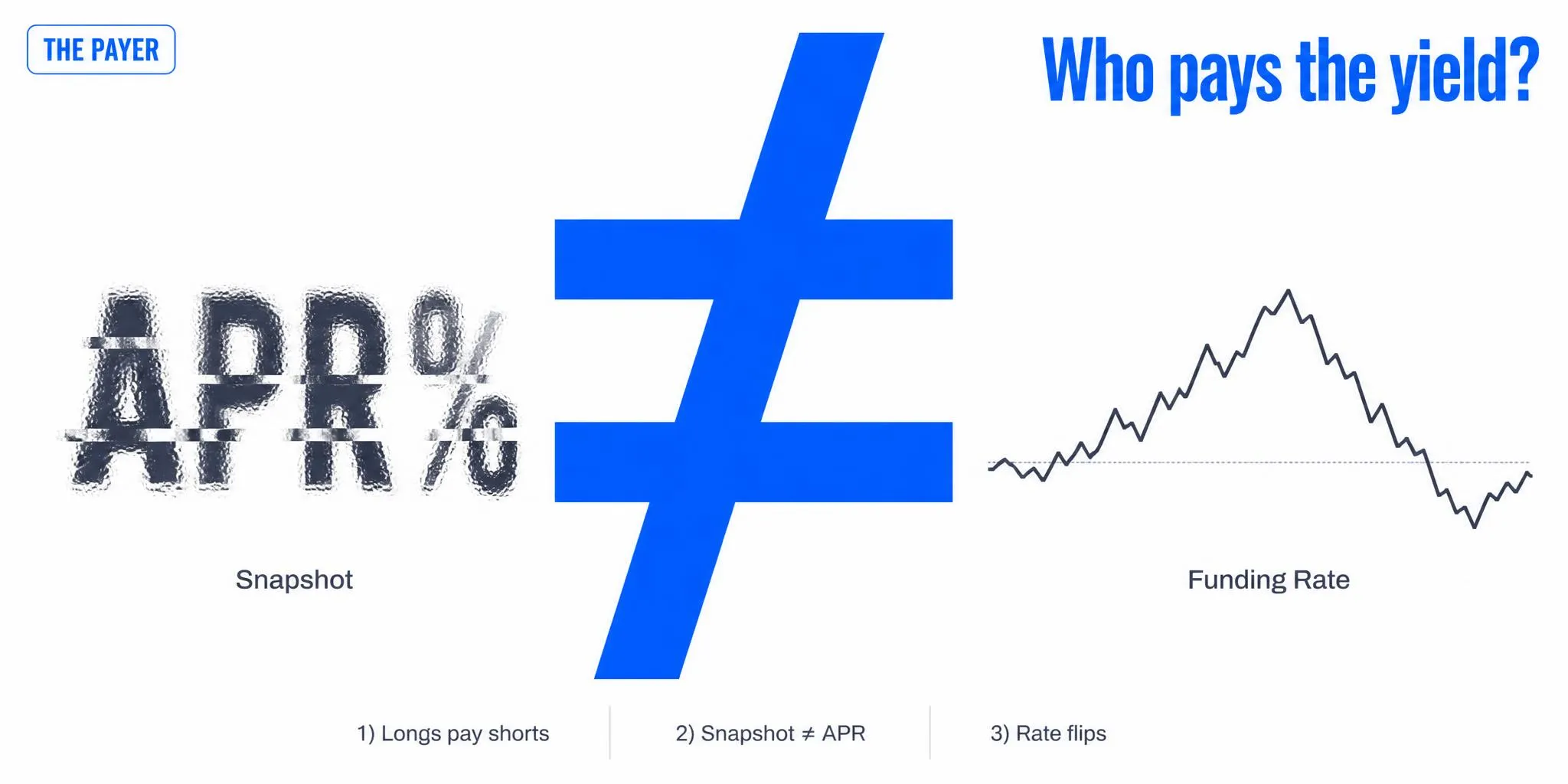
Funding is one cash-flow component. It is not interest generated by USDT itself, and a displayed funding rate is not the strategy’s net APY.
Where the payment comes from
Perpetual futures do not expire on a fixed delivery date. Funding payments help maintain the relationship between the contract price and its spot reference.
| Settled funding rate | Who pays? | Who receives? |
|---|---|---|
| Positive | Long positions | Short positions |
| Negative | Short positions | Long positions |
| Zero | Neither side pays funding for that settlement | Neither side receives funding |
The venue’s formula determines the rate. Do not infer it solely from a momentary comparison of spot and perpetual prices: reference indices, observation windows and other parameters can matter. OKX’s funding documentation explains payment direction and calculation.
Funding schedules vary by contract. An eight-hour example is not a rule for every market.
How the hedge works
Imagine holding an asset in the spot market and an offsetting short perpetual exposure to that asset. If the asset price rises, the spot holding gains while the short generally loses. If it falls, the relationship reverses.
The aim is to reduce net sensitivity to the asset’s price. The offset is approximate in practice: spot and perpetual prices can diverge, contract sizing matters, and execution is not necessarily simultaneous.
The strategy can receive positive funding on the short while maintaining the spot hedge. If funding turns negative, that same short position can become a funding expense.
USDT supplied to a product may therefore be converted or allocated into assets and collateral behind the scenes. The deposit currency does not identify all the strategy’s exposures.
Calculate gross funding first
Suppose the perpetual position has $10,000 notional, and the hypothetical settled funding rate is +0.01%.
Funding payment = $10,000 × 0.0001 = $1
The short receives $1 for that settlement. This is a payment on derivative notional, not a 1% return on the user’s capital.
If an illustrative contract has three settlements a day and the same rate holds for all three, gross funding is $3 that day. That assumption is only for arithmetic. It is not a forecast of the next settlement or the next year.
A complete gross-to-net example
Assume the following hypothetical ten-day result. The numbers are invented for explanation and do not describe a product’s performance or current fees.
| Component | Amount |
|---|---|
| Total net funding received across all settlements | +$30 |
| Trading fees for opening and closing both legs | −$12 |
| Slippage and execution cost | −$5 |
| Combined spot/perpetual price P&L, excluding the separately listed costs | −$4 |
| Other strategy costs | −$2 |
| Net result | +$7 |
The funding row already includes any negative funding payments in the period. Do not subtract them again. Likewise, if your reported trading P&L already includes fees or slippage, adjust the presentation to avoid double counting.
This is why a funding screenshot cannot establish net performance. Execution costs and changes in the hedge can consume much of the gross payment.
Return on notional is not return on total capital
The hedge can require capital for the spot holding, derivative collateral and reserves.
If the example uses $10,000 for spot and another $10,000 for margin and reserves, total allocated capital is $20,000. A $7 net result is 0.035% over the ten-day period on that capital.
Those capital figures illustrate the denominator; they are not a recommended margin allocation or a promise of liquidation protection. Collateral models, leverage and margin requirements differ by venue.
An opportunity cost is also different from a cash expense. Capital committed to a hedge might have earned something elsewhere, but that hypothetical alternative should not be silently mixed with fees actually paid.
What delta-neutral does not protect against
Funding reversal
Positive funding is not permanent. Keeping the same positions when it becomes negative can turn receipts into payments.
Basis changes
The difference between spot and perpetual prices can widen or narrow. Closing the hedge at different relative prices affects combined P&L even if broad directional exposure was reduced.
Margin and liquidation
A gain in the spot account may not be available as collateral in the derivatives account. A rapid move can create margin pressure before capital can be transferred or positions adjusted.
Execution and rebalancing
One leg may fill while the other fails or fills at a worse price. Position adjustments add costs and can temporarily leave directional exposure.
Venue and protocol dependencies
Exchange balances depend on the venue’s operations and custody. An on-chain leg can add contract and network risks. Bridges, managers and multiple venues can introduce further dependencies.
The relevant question is what the actual strategy uses, not whether its marketing label includes “arbitrage.”
How to assess a funding-based yield product
Ask for evidence that connects the mechanism to user outcomes:
- Which contracts and venues generate the funding?
- Is the displayed rate a snapshot, an estimate or realized net performance?
- What capital is included in the return denominator?
- Are fees, negative funding and hedge P&L accounted for consistently?
- How are margin and cross-venue transfers managed?
- What asset does the user hold, and what conditions govern redemption?
A product accepting USDT may combine funding with lending, basis trades or incentives. Do not attribute all its return to funding unless its documentation and reporting support that conclusion.
For comparison with other mechanisms, see ways to earn on USDT. The wallet-versus-exchange guide explains a separate question: who controls access to the funds.
FAQ
Is funding-rate arbitrage risk-free?
No. It targets a reduction in directional exposure, while funding, basis, execution, margin and counterparty risks remain.
Can shorts pay funding?
Yes. With negative settled funding, shorts pay longs under the standard payment convention described above.
Is the funding rate an annual interest rate?
A per-settlement rate applies to that settlement and position value. Annualized displays require assumptions and do not guarantee a year’s realized return.
Does every strategy use leverage?
The derivative has a margin framework, but effective leverage depends on total collateral and capital allocation. Do not assume a particular leverage level from the strategy’s name.
Why can positive funding still produce a loss?
Costs and losses in other components can exceed the funding received. Evaluate the whole position over the same period.
Disclaimer
This article is for informational purposes only and is not financial, investment, legal, or tax advice. Crypto products, stablecoins, on-chain protocols, and yield-bearing tokens involve risk, including possible loss of funds. USDRL is designed to be USDT-pegged and yield-bearing, but peg stability, yield, liquidity, and redemption are not guaranteed. Always do your own research, understand the risks, and never deposit more than you can afford to lose.