What “Up to” APR Means in USDT Earn: Tiers & Caps Explained
Contents
You see a listed rate of something like “Up to 15% APR” on a USDT Earn product. You deposit 1,000 USDT expecting 15% on the whole stack. A month later, the actual yield you receive feels closer to half that number. Nothing broke. You just met the industry’s most effective marketing phrase: “up to.”
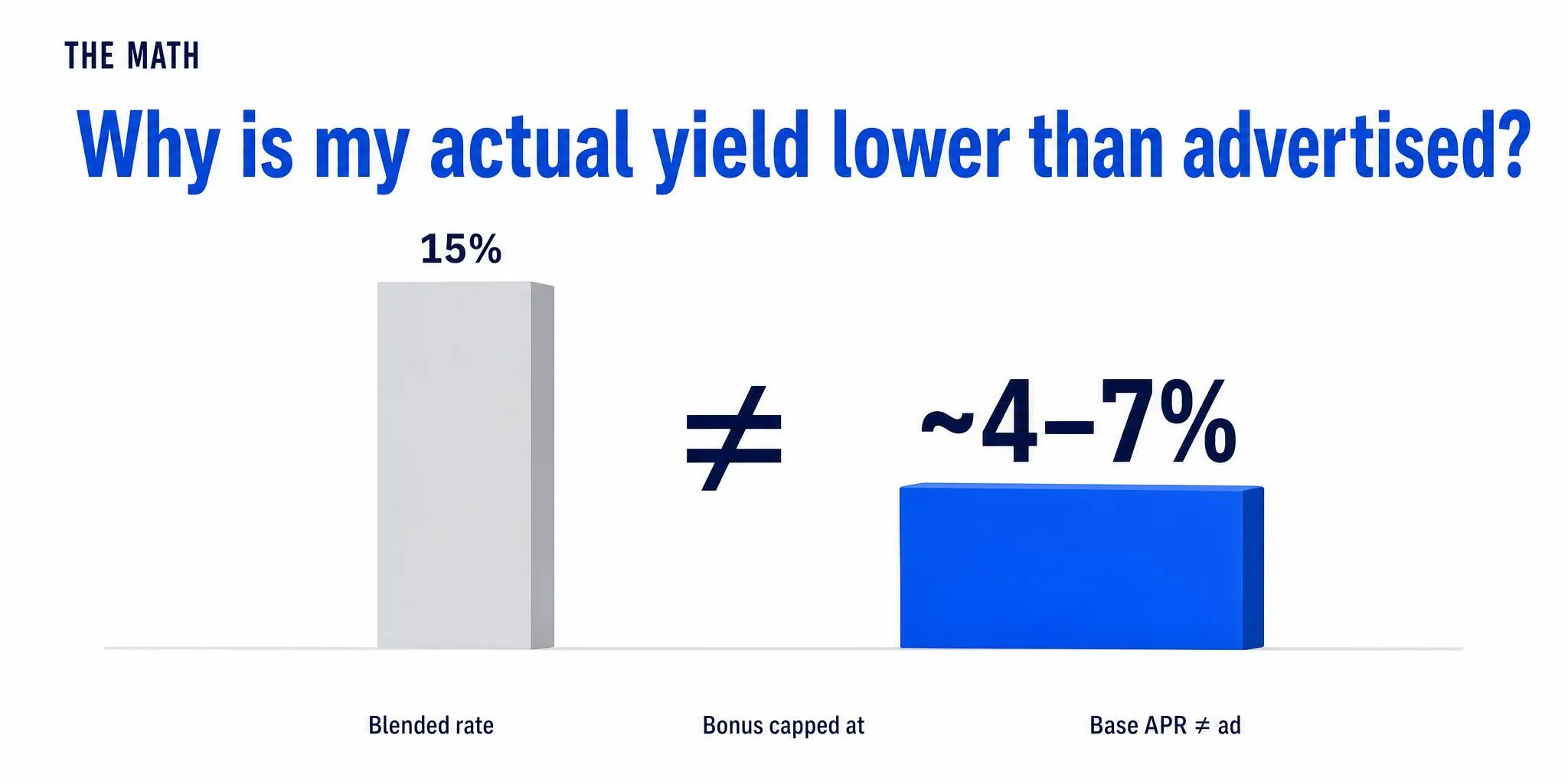
“Up to X% APR” is not the same as “your full balance earns X%.” In many earn products, that headline combines a base rate with a bonus APR that applies only to a limited slice of your deposit, a short time window, or both. The account might show 15%, but your blended annual rate on the full balance might be closer to 4–7% once you do the math.
Knowing that gap exists is different from knowing how to spot it ahead of time. This article walks through the tier mechanics, the bonus rules, and the six-step calculation that lets you convert any “up to” headline into your actual expected return — before you deposit.
Quick answer: what “up to” really means
- The headline rate usually bundles two things: a base (real-time) APR everyone earns on the full balance, plus a bonus APR reserved for a capped tier — often the first 200, 500, or 1,000 USDT.
- The bonus tier is not your whole deposit. If you put in 5,000 USDT and the bonus applies only to the first 500, the remaining 4,500 earns the base rate alone.
- APR is annualized. A 30% promotional bonus that lasts five days amounts to about 0.41% of the eligible slice over those five days, not 30% of your balance as cash.
- The product cap is not the bonus cap. “Unlimited subscription” can coexist with a bonus applied to only the first portion. Those two limits are separate and you have to check both.
The three parts of a displayed “up to” rate
When a platform shows a single large number for a USDT Earn product, open the terms and look for three separate components. They are rarely spelled out in the ad itself.
1. Base APR (sometimes called Real-Time APR)
This is the rate the underlying yield mechanism generates before any promotional top-up. It is usually variable and can change daily. On some CEX Earn products, the real‑time APR moves with demand for stablecoin lending, funding‑rate conditions, or the platform’s revenue allocation. It applies to your full deposit.
2. Bonus APR (also called Bonus Tiered APR or Promotional APR)
A top-up rate added to the base, funded by the platform’s marketing or incentive budget rather than by economic yield. The bonus is time‑boxed — often for a launch window, a special event, or a limited number of days — and it only rewards a defined cap. “First 500 USDT earn an extra 20% APR for 5 days” is a common shape. Anything above 500 USDT does not receive the bonus, and once the 5 days end the bonus drops away regardless of your balance.
3. Eligible balance (the tier cap)
The smallest number in the offer and the one that matters most. The bonus-tier cap tells you how much of your deposit gets the headline rate. If the cap is 200 USDT and you deposited 1,000, only 20% of your money sees the bonus component.
| Component | Applies to | Duration | What to check |
|---|---|---|---|
| Base / Real‑Time APR | Full deposit | Ongoing (but variable) | Changes with market conditions; always re‑check before subscribing |
| Bonus APR | Only the cap‑limited slice (e.g. first 500 USDT) | Fixed promotional window (e.g. 5, 7, or 14 days) | Expiry date and whether new deposits qualify after the promotion starts |
| Eligible balance cap | The portion of your balance that gets bonus APR | Tied to the promotion | Is it a per‑account or per‑product cap; does it reset after the window |
The six-step framework: from ad to effective APR
Before depositing into any product that advertises an “up to” rate, run these six steps. They work whether you are looking at a CEX Earn product or a protocol that uses tiered incentives.
- Split your balance into the bonus‑eligible tier and the remainder.
- Apply the bonus APR only to the eligible tier for the exact number of days the promotion runs.
- Apply the base APR to the full balance, or to the remainder after any tier cap that changes the base rate.
- Weight the two rates by the portion of the balance that earns each one. That gives you the blended APR.
- Convert the annualized blended APR into a daily rate and multiply by the number of days the promotion actually lasts.
- Separate promotional revenue from ongoing revenue. After the promotion ends, only the base APR remains.
Three worked examples: 200 USDT, 1,000 USDT, 10,000 USDT
Assume a product running this offer (illustrative — check live terms before depositing):
- Base (Real‑Time) APR: 3%
- Bonus APR: 20% for the first 500 USDT
- Bonus duration: 7 days
- Subscription cap per user: unlimited
These numbers are not a live promotion. I am using them because the structure is common and they make the mechanics visible.
Example 1: Deposit 200 USDT (entire balance within the bonus tier)
- Bonus slice: 200 USDT × 20% × (7 / 365) ≈ 0.77 USDT
- Base slice: 200 USDT × 3% × (7 / 365) ≈ 0.12 USDT
- Total 7‑day reward at the bonus level: ≈ 0.89 USDT
- Annualised blended rate during the promotion: ~23%
Post‑promotion: once those 7 days end, the product delivers only the 3% base on the full 200. Over a full year — 7 days of blended ~23% and 358 days at 3% — the effective annual return drops to roughly 3.4%.
Example 2: Deposit 1,000 USDT (bonus tier covers half)
- Bonus slice: 500 USDT × 20% × (7 / 365) ≈ 1.92 USDT
- Base slice on full balance: 1,000 USDT × 3% × (7 / 365) ≈ 0.58 USDT
- Total 7‑day reward: ≈ 2.50 USDT
- Blended APR during the 7 days: about 13%
Post‑promotion: the remaining 358 days apply 3% to the whole 1,000 USDT, producing around 29.40 USDT more. The full‑year effective APR lands near 3.2% — a long way from the advertised 23% blend.
Example 3: Deposit 10,000 USDT (bonus tier is a thin slice)
- Bonus slice: 500 USDT × 20% × (7 / 365) ≈ 1.92 USDT
- Base slice on full balance: 10,000 USDT × 3% × (7 / 365) ≈ 5.75 USDT
- Total 7‑day reward: ≈ 7.67 USDT
- Blended APR during the 7 days: about 4%
Post‑promotion: base rate across the full 10,000 adds roughly 294.20 USDT over the rest of the year. The full‑year effective rate is barely above 3%. The bonus barely moved the needle for a large balance, even though the displayed number during the promotion looked far higher.
Four things that reduce actual rewards beyond the tier cap
The six‑step calculation gives you a clean expected return on paper. In practice, five other mechanics eat into that number.
1. First‑come‑first‑served bonus pools. Some promotions cap the total bonus payout across all users — e.g. 50,000 USDT in bonus rewards for the whole pool. Once the pool is exhausted, late subscribers get only the base rate, even if the promotion is still officially running.
2. Eligibility rules. A bonus might apply only to “new deposits made during the promotion window,” or only to users who have never held the product before. Transferring 1,000 USDT you already held in the exchange wallet to the Earn product may not count.
3. Snapshot timing. A few products use daily snapshots. If your deposit lands after the snapshot, the bonus accrual starts the next day. For a seven‑day promotion, losing the first day cuts bonus-eligible time by 14%.
4. Real‑time base APR movement. The base rate can drop within the promotion window. If the base APR halves halfway through, your blended return over the remaining days falls with it. The headline “up to” number reflects conditions at the moment of advertising, not your average across the holding period.
5. Early redemption or subscription‑timing mismatch. If the product has a redemption delay or holds your funds while the promotion is already running, you may miss bonus days you assumed you would get.
Separate the product subscription cap from the bonus‑tier cap
One of the most persistent misunderstandings: seeing “Unlimited USDT subscription” and assuming the bonus APR also has no limit.
A product subscription cap controls how much USDT you can put into the product at all. A separate bonus‑tier cap controls which slice of that balance gets the bonus rate. They are independent.
Example from the Binance Simple Earn Flexible Product terms for USDT (referenced from official FAQs published for certain promotional windows): a user could subscribe a balance significantly larger than the bonus tier, but the bonus APR was explicitly stated to apply only to the first 200 or 500 USDT for a defined period. Binance’s FAQ on Simple Earn Flexible Product bonus APR is a concrete reference that describes this split. Under “What is the Bonus Tiered APR and how does it work?” you see the precise tier limits and how the real-time APR applies in parallel.
When you open the product page, find the subscription cap first. Then find the bonus tier limit. If the second number is smaller, run the blended calculation. If only the subscription cap is visible and the bonus tier is buried in a separate FAQ or announcement, that is the first warning sign.
Bonus and base can accrue or distribute on different schedules
Another practical gap: the base APR might accrue daily and distribute every 24 hours, while the bonus accrues only at the end of the promotion and pays out separately a few days later. Looking at your balance mid‑promotion and seeing only the base component arrive does not mean the bonus was not earned — but it does make the payout cadence less predictable than the displayed APR implies.
Check the reward‑distribution section of the terms for phrases like “bonus rewards will be distributed within 3 working days after the promotion ends” or “real‑time rewards accrue daily; bonus rewards are credited after the promotion.” This matters if you are comparing two products side by side: one where the headline APR delivers steady daily payouts versus one where most of the headline number drops in a delayed lump sum.
Common mistakes when comparing “up to” USDT Earn products
Mistake 1: Comparing headline APRs directly. A 25% APR on a 200‑USDT tier for 5 days tells you nothing about a 6% flat‑rate product on the full balance until you run the numbers for your balance size.
Mistake 2: Dropping the time dimension. Annualized numbers on a short window inflate the perceived size of the reward. A 30% annualized rate over 5 days on 500 USDT returns roughly 2 USDT. That is the cash number that actually lands in your account, not 30% of 500.
Mistake 3: Forgetting that bonus APR is marketing spend, not sustainable yield. The platform’s support announcement usually states the bonus is funded by the platform, not by the underlying strategy. Binance’s announcement for its Bonus Tiered APR promotions notes that the “Bonus Tiered APR is an extra reward subsidized by Binance.” When the marketing budget for that campaign ends, the bonus ends. It is not evidence that the underlying economic yield permanently supports that rate.
Mistake 4: Assuming the rate shown today is the rate you will earn next week. Real‑time APR is variable by design. A snapshot that looked attractive on Monday may be lower by Friday. Before subscribing, check the recent real‑time APR history, not just today’s number.
When a tiered or capped yield program actually makes sense
Tiered bonus structures are not inherently bad. They simply reward different behaviors.
A short‑duration bonus on a modest tier is effectively a small acquisition incentive — useful if you were planning to keep USDT on that platform anyway and the base rate is competitive after the promotion ends. For large balances sitting for months, a flat‑rate, transparent product where the displayed APY applies to the entire balance without bonus games is often the simpler and more predictable option.
The decision framework is straightforward: calculate your effective annual return at your actual balance size, using only the base rate for the portion that exceeds the bonus tier, and ask whether the post‑promotion ongoing rate meets your needs. If the product only looks good while the bonus is running, you are being paid to onboard, not to stay.
For a deeper dive into how USDT APR and APY relate to yield sources, lock‑up rules, and risks, the piece USDT APR vs APY: Yield Sources, Lock-ups and Risks Explained unpacks that side of the comparison. And on why variable rates move — and can fall to zero — Why Does USDT APY Change? What Makes Yield Rise, Fall or Vanish covers the drivers.
FAQ
What is APR in Binance USDT Earn products?
APR (Annual Percentage Rate) on Binance USDT Earn products is the annualized rate displayed before compounding. It does not include the effect of daily compounding (that would be APY). Often, Binance splits the displayed APR into a Real‑Time APR (variable, applied to the full balance) and a Bonus Tiered APR (fixed for a promotion, applied only to a capped amount for a set number of days). The exact split is described in each product’s terms or announcement.
Why is my actual USDT yield lower than the advertised APR?
The most common reason: the advertised “up to” APR includes a bonus that applies only to a fraction of your deposit — say the first 200 or 500 USDT — while the rest earns a lower base rate. A short promotion window (e.g. 5 days) further shrinks the cash reward relative to the annualized number. Variable base rates that drop after you deposit also reduce your realized yield.
Does bonus APR apply to all my USDT balance or just new deposits?
It almost never applies to the full balance. The bonus normally applies to a capped tier (e.g. the first 500 USDT), and some promotions restrict it further to “new deposits made during the event period.” You need to check three conditions: the tier cap, whether your deposit qualifies as new, and whether the bonus pool has been exhausted.
Are tiered interest rates good?
They can be useful for small balances that fit entirely within the bonus tier. For balances significantly larger than the bonus cap, the blended effective APR is usually much closer to the base rate, and the real value of the promotion is the small one‑time reward, not the headline percentage. Whether it is good depends on whether the post‑promotion ongoing rate is competitive for your balance size.
Is APR better than APY in crypto?
Neither is “better” — they measure different things. APR is the simple annual rate without compounding. APY includes the effect of compounding over a year. When compounding is frequent (daily), the APY will be slightly higher than the APR for the same stated rate. The more important distinction for a decision is whether the rate is variable or fixed, and whether it applies to your full balance or a capped tier.
If an “up to” headline ever makes you pause, run the numbers for your actual balance. The math is simple, and the gap between the displayed number and your real return will tell you more than any rating ever could.
Disclaimer
This article is for informational purposes only and is not financial, investment, legal, or tax advice. Crypto products, stablecoins, on-chain protocols, and yield-bearing tokens involve risk, including possible loss of funds. TRUSD is designed to be USDT-pegged and yield-bearing, but peg stability, yield, liquidity, and redemption are not guaranteed. Always do your own research, understand the risks, and never deposit more than you can afford to lose.