Is Delta-Neutral Yield on Stablecoins Really Safe?
Contents
Delta-Neutral Yield Explained: What It Hedges — and What Risks Remain
You look for ways to make idle USDT productive and keep running into the phrase “delta-neutral.”
It sounds reassuring. Sometimes it is presented almost like a safety label.
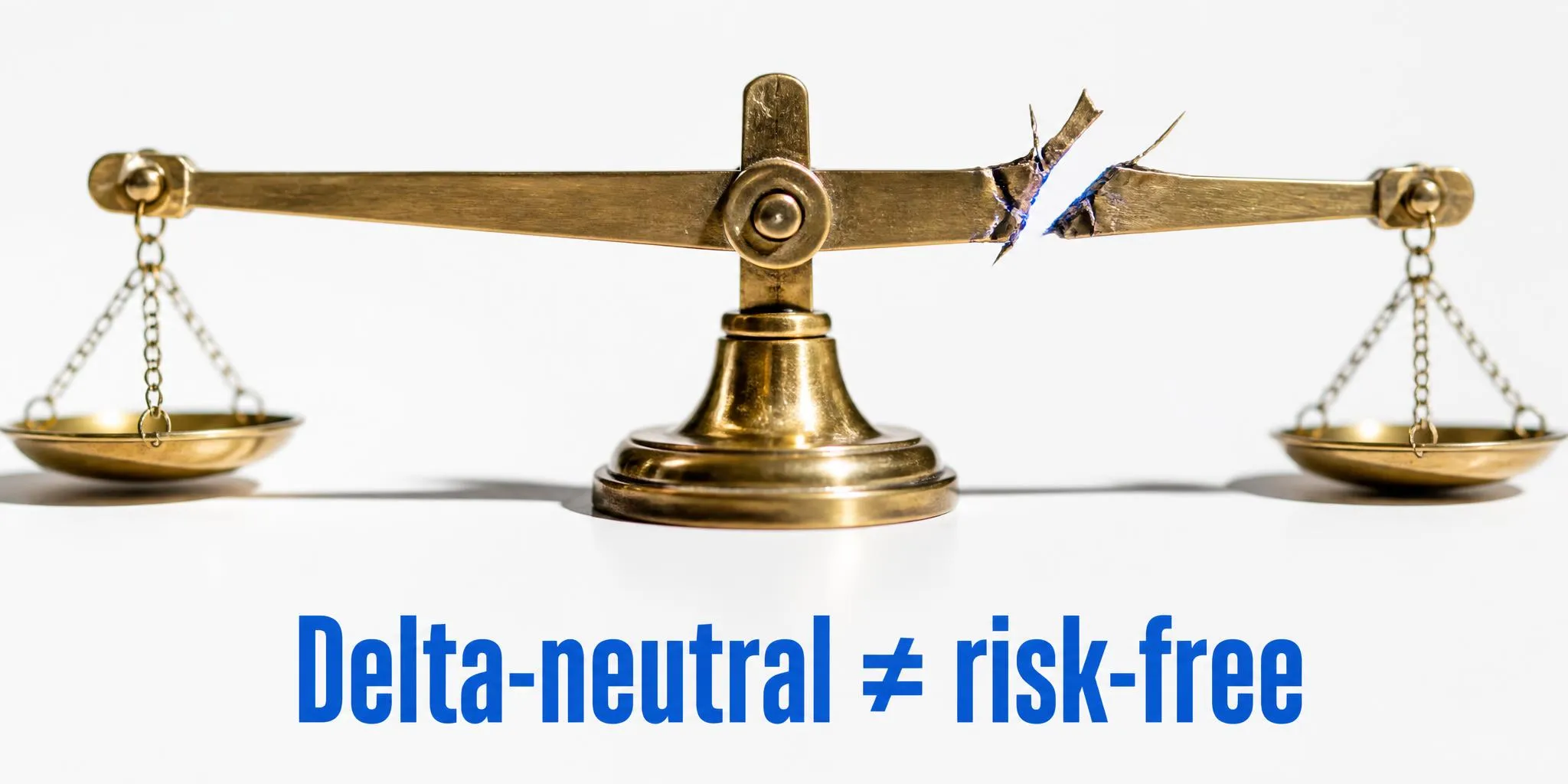
But “delta-neutral” describes only one part of a strategy: its sensitivity to directional price moves. It does not tell you where the yield comes from, whether the hedge will remain balanced, or what other risks sit underneath the product.
Quick answer: a delta-neutral strategy combines opposing exposures so that ordinary moves in an underlying asset should have a limited effect on the portfolio’s value. In crypto, one common structure pairs a long spot position with an offsetting short perpetual-futures position. The hedge can reduce directional price risk, while funding-rate, basis, execution, margin, venue, smart-contract, liquidity, redemption and operational risks remain.
The useful question is not simply:
“Is this strategy delta-neutral?”
It is:
“What is neutralized, what generates the return, and what can break the hedge?”
What “delta” means in plain English
Delta is a way of describing directional sensitivity:
If the underlying asset moves, how much should this position move with it?
For example, owning 1 BTC creates roughly one BTC of long directional exposure. A short BTC perpetual position of approximately the same size creates opposing directional exposure.
Put the two together and much of the effect of a normal BTC price move can offset.
The CME Group introduction to delta explains the broader concept of delta as a measure of how a position responds to changes in the underlying asset. Its examples focus on options, where delta itself changes as market conditions change.
For a spot-plus-perpetual strategy, the practical idea is simpler:
Size a long and a short position so their directional exposures approximately offset.
That is what “neutral” refers to.
It does not mean the entire portfolio is neutral to every source of loss.
A simple spot-plus-perpetual example
Imagine a strategy holds roughly $10,000 of BTC spot and opens a short BTC perpetual position with approximately $10,000 of matching directional exposure.
If BTC rises 5%:
- the spot leg gains roughly $500;
- the short perpetual leg loses roughly $500.
If BTC falls 5%:
- the spot leg loses roughly $500;
- the short leg gains roughly $500.
The two sides are designed to offset much of the directional move.
This simplified structure is one form of the offsetting exposure described in OKX’s introduction to delta-neutral strategies.
The important word is roughly.
Real portfolios have fees, execution differences, funding settlements, margin requirements and changing position sizes. The two legs will not necessarily produce perfectly opposite results at every moment.
So:
Delta-neutral does not mean “the price cannot hurt us.”
It means:
“We are deliberately trying to prevent price direction from being the main driver of the portfolio’s return.”
Delta-neutral is not the source of yield
This distinction matters.
A hedge reduces a type of risk. It does not create income by itself.
Yield still needs an economic source.
In a spot-plus-perpetual structure, one possible source is funding payments. When funding is positive, traders holding long perpetual positions generally pay traders holding short positions. A strategy holding spot and an offsetting perpetual short may therefore receive funding while reducing its directional BTC exposure.
Funding can also fall or reverse, turning that revenue source into a cost.
The detailed mechanics belong in the separate guide to funding-rate arbitrage.
Another possible source is basis or carry: capturing differences between related spot and derivatives prices under a defined strategy.
For the broader map of lending, funding, basis and other sources, see Where Does USDT Yield Actually Come From?.
The important principle is:
Delta-neutral is a risk configuration. Funding, basis or another economic mechanism must still produce the return.
Why “neutral now” does not mean “neutral forever”
A hedge is something that has to be maintained.
Prices move. Position values change. Contracts behave differently. Collateral and margin conditions can change.
That means a portfolio designed to have approximately zero net directional exposure at one moment can drift away from that target later.
Maintaining the hedge may require rebalancing.
And rebalancing has costs:
- trading fees;
- bid-ask spreads;
- slippage;
- additional collateral movements;
- execution risk while one leg is adjusted before the other.
During calm markets, these effects may be small.
During sharp moves or thin liquidity, they can become much more important.
So a useful due-diligence question is not just:
“Is the strategy delta-neutral?”
Ask:
“How is the hedge monitored and rebalanced, and what happens when it cannot be adjusted normally?”
The three-layer risk stack
The easiest way to understand a delta-neutral product is to separate its risks into three layers.
Layer 1: Directional price risk
This is the risk the hedge is actually trying to reduce.
If the strategy owns BTC and shorts roughly the same BTC exposure, a normal BTC price move should have a much smaller effect on total portfolio value than it would on an unhedged BTC position.
That can be useful.
But it is only one dimension of risk.
Layer 2: Strategy risk
These risks remain even when directional exposure is small.
Funding-rate risk
Positive funding can shrink or turn negative. A source of income can therefore become a cost.
Basis risk
The relationship between spot and derivatives prices can move differently from the assumptions made when the position was opened or unwound.
Execution and leg risk
The two sides of the hedge may not execute at exactly the same time or price. One market can remain liquid while the other becomes difficult to trade.
Margin and liquidation risk
A derivatives leg can require collateral and be subject to margin rules. Using leverage or insufficient collateral can create liquidation risk even if the overall portfolio is intended to be directionally hedged.
Rebalancing cost
Maintaining the target exposure requires trading. More volatility can mean more adjustments and higher costs.
Layer 3: Product and infrastructure risk
These risks exist outside the hedge itself.
Venue and counterparty risk
A strategy may depend on centralized trading venues. Withdrawal restrictions, operational failures or counterparty problems can affect one side of the position.
Smart-contract risk
Onchain vaults, tokens, bridges, oracles and other contracts introduce code and protocol risk.
Liquidity risk
The strategy may be economically solvent while still being unable to convert positions into usable assets quickly without significant slippage.
Redemption risk
A user-facing product may need liquidity or strategy unwinds before the user can return to the underlying asset.
Operational and model risk
Automation, execution logic, data feeds and risk models can fail or behave differently from expectations under unusual market conditions.
| Risk layer | Does delta-neutral solve it? | Example |
|---|---|---|
| Directional price risk | Designed to reduce it | BTC rises while long spot and short perp approximately offset |
| Funding / basis risk | No | Funding falls or reverses |
| Execution / margin risk | No | One leg moves before the hedge is adjusted |
| Venue / counterparty risk | No | Assets become temporarily inaccessible on a venue |
| Smart-contract risk | No | A contract or oracle fails |
| Liquidity / redemption risk | No | Positions cannot be unwound quickly at reasonable prices |
This is the central point:
“Neutral” describes the hedge against a market factor. It does not describe the total risk of the product.
Delta-neutral vs market-neutral
The two terms are often used loosely.
Delta-neutral usually refers specifically to reducing first-order directional sensitivity to an underlying asset.
Market-neutral is broader and can describe strategies intended to reduce exposure to one or more market factors.
Neither term is equivalent to:
- risk-free;
- principal-protected;
- guaranteed yield;
- guaranteed liquidity.
Whenever a product uses either label, the next question should be:
Neutral to what?
What to ask instead of “Is it delta-neutral?”
A useful review of a yield product can start with six questions.
1. What exactly is hedged?
Which asset creates the directional exposure, and what position offsets it?
2. What actually generates the yield?
Funding payments? Basis? Lending? Incentives? Several mechanisms?
If the answer is only “algorithms” or “AI,” the economic source has not been explained.
3. Where do the positions and collateral sit?
Centralized exchanges? Smart contracts? Multiple venues?
The location of the assets creates risks that the hedge itself cannot remove.
4. How is neutrality maintained?
How can exposure drift? What causes rebalancing? What execution costs can appear?
5. What can force an unwind?
Possible triggers include margin pressure, changing liquidity, venue problems or user redemptions.
6. What happens when users want their USDT back?
A product can have a hedged strategy while still having liquidity and redemption constraints.
Keep one rule in mind:
Ask what is neutralized, what generates the return, and what can force the hedge to break.
How this can appear inside a USDT savings product
Some onchain savings products use delta-neutral funding-rate or basis strategies underneath a simpler user-facing experience.
For example, Reinforce.fi can use funding-rate and basis opportunities as some of several underlying yield sources. Users receive USDRL, while strategy allocation, execution and hedge management happen underneath the product. Automated systems and reinforcement learning can help optimize allocation and execution; they do not create the economic yield themselves.
That removes the need for an ordinary USDT holder to run derivatives positions manually, but it does not remove strategy, venue, liquidity, smart-contract or redemption risk.
The same framework still applies:
What is hedged? What creates the yield? What risks remain?
FAQ
Does delta-neutral mean risk-free?
No.
It means a portfolio is structured to reduce sensitivity to a particular directional market move. Funding, basis, execution, margin, liquidity, venue, smart-contract and operational risks can remain.
Can a delta-neutral strategy lose money?
Yes.
Losses can come from adverse funding or basis conditions, execution problems, liquidation or margin events, liquidity constraints, venue failures, smart-contract issues and other risks outside the directional hedge.
Does delta-neutral automatically generate yield?
No.
The return must come from a separate economic mechanism such as funding payments or basis/carry. Delta-neutrality is the hedge structure around that mechanism.
Do I necessarily keep holding the original USDT in an Earn product?
Not necessarily.
Different products work differently. A user may hold an account claim, a protocol position, a receipt or share token, or a separate yield-bearing token. The important questions are what asset or claim the user holds after depositing and how it can be converted back to usable USDT.
The takeaway
Delta-neutral strategies solve a narrower problem than the name can suggest.
They can reduce directional exposure to an asset such as BTC or ETH. That can make it possible for another return source — such as funding or basis — to matter more than whether the market simply goes up or down.
But the hedge does not erase the rest of the risk stack.
Before evaluating a product by its APY or its “delta-neutral” label, ask three things:
What is neutralized?
What actually creates the return?
What can break the hedge or delay the exit?
If those answers are clear, “delta-neutral” becomes useful information rather than a marketing shortcut.
Disclaimer
This article is for informational purposes only and is not financial, investment, legal, or tax advice. Crypto products, stablecoins, on-chain protocols, and yield-bearing tokens involve risk, including possible loss of funds. USDRL is designed to be USDT-pegged and yield-bearing, but peg stability, yield, liquidity, and redemption are not guaranteed. Always do your own research, understand the risks, and never deposit more than you can afford to lose.